The 50/30/20 Rule vs. Zero-Based Budgeting presents a crucial decision for anyone aiming to build substantial wealth. Indeed, effective money management forms the bedrock of financial security. For beginner investors, understanding various budgeting methods is paramount. Therefore, this article will explore both popular strategies. We will compare their strengths and weaknesses. Consequently, you can decide which approach aligns best with your financial goals.
Understanding the 50/30/20 Rule
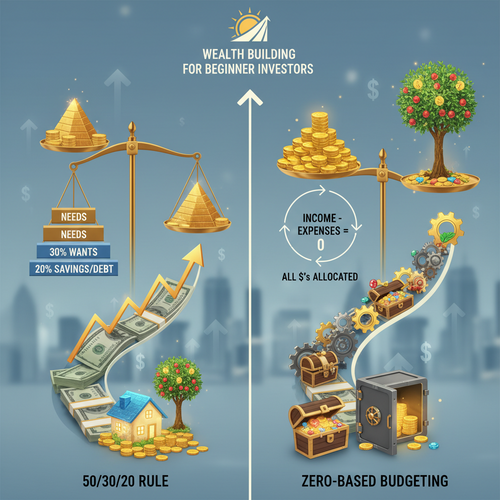
The 50/30/20 Rule offers a straightforward approach to personal finance. Specifically, it divides your after-tax income into three main categories. Fifty percent covers your needs. Necessities include housing, utilities, and groceries. Thirty percent is allocated to your wants. This category encompasses dining out, entertainment, and hobbies. Furthermore, twenty percent goes towards savings and debt repayment. This portion is crucial for building future wealth. Therefore, it simplifies financial planning considerably.
Advantages of the 50/30/20 Rule
- Simplicity: It is exceptionally easy to understand and implement. Many beginners find this structure less intimidating.
- Flexibility: The rule provides broad guidelines. Thus, it allows for personal discretion within each category.
- Quick Start: You can begin budgeting almost immediately. Consequently, it promotes early adoption of good financial habits.
Disadvantages of the 50/30/20 Rule
- Less Granular: It lacks detailed insight into specific spending habits. Therefore, it might not identify areas for significant cuts.
- Assumes Income Levels: This rule works best for consistent, middle-income earners. Lower incomes might struggle to fit essentials into 50%.
- Potential for Overspending on Wants: A full 30% for wants can be high for aggressive savers. Conversely, it might hinder faster wealth accumulation.
Exploring Zero-Based Budgeting
Zero-Based Budgeting (ZBB) employs a different philosophy. Essentially, it requires you to assign every dollar of your income a specific job. Each month, your income minus your expenses should equal zero. Therefore, you meticulously plan where every single dollar goes. This method typically begins with identifying all income sources. Subsequently, you list every expense. This includes fixed and variable costs. Consequently, every dollar has a purpose. No money is left unaccounted for.
1. Maximum Financial Control
ZBB provides complete visibility into your finances. You know exactly where your money is going and why.
2. Identifies Waste and Inefficiencies
Because every expense must be justified, unnecessary spending becomes obvious:
-
Unused subscriptions
-
Impulse purchases
-
Lifestyle creep
3. Accelerates Wealth Building
By eliminating waste, more money is available for:
-
Investments
-
Retirement
-
Business ventures
-
Extra debt payments
This optimization significantly increases wealth-building speed.
4. Strong Debt Reduction Focus
ZBB encourages intentional debt payoff strategies, helping users eliminate high-interest debt faster.
5. Ideal for Goal-Oriented Individuals
If you’re saving for:
-
Financial independence
-
Early retirement
-
Real estate
-
Business investment
ZBB provides unmatched precision.
Advantages of Zero-Based Budgeting
- Maximum Control: ZBB gives you a complete overview of your finances. Indeed, you know precisely where your money is going.
- Identifies Waste: This detailed tracking often reveals unnecessary expenditures. Thus, you can optimize your spending efficiently.
- Faster Wealth Building Potential: By minimizing waste, more money becomes available for savings and investments. Consequently, wealth can grow more rapidly.
- Debt Reduction Focus: It encourages dedicated allocation towards debt. Furthermore, this accelerates your path to financial freedom.
Disadvantages of Zero-Based Budgeting
- Time-Consuming: Creating and maintaining a ZBB budget requires significant effort. Specifically, it needs regular updates.
- Requires Discipline: Strict adherence to the budget is crucial. Therefore, it might be challenging for those new to budgeting.
- Less Flexible: Unexpected expenses can disrupt the budget. Subsequently, constant adjustments become necessary.
50/30/20 Rule vs. Zero-Based Budgeting: A Direct Comparison
Both methods aim to help you manage money better. However, their approaches differ significantly. The 50/30/20 Rule prioritizes simplicity and ease of use. Conversely, ZBB emphasizes granular control and optimization. For instance, the 50/30/20 Rule might tell you to spend 30% on wants. Zero-Based Budgeting, however, asks if each “want” aligns with your goals. Consequently, it often leads to more conscious spending decisions.
Furthermore, setting up the 50/30/20 Rule takes minutes. Implementing ZBB, conversely, might take hours initially. It also requires ongoing commitment. Therefore, your personal finance style and available time are crucial considerations. New budgeters might find the 50/30/20 Rule a gentle introduction. More experienced or highly motivated individuals might prefer ZBB for its depth.
50/30/20 Rule vs. Zero-Based Budgeting: A Direct Comparison
| Feature | 50/30/20 Rule | Zero-Based Budgeting |
|---|---|---|
| Complexity | Low | High |
| Time Commitment | Minimal | Significant |
| Spending Awareness | Moderate | Very High |
| Flexibility | High | Moderate |
| Wealth Growth Speed | Moderate | Fast |
| Best For | Beginners | Goal-driven savers |
Which Method Builds Wealth Faster?
Determining which method builds wealth faster depends heavily on individual execution. Theoretically, Zero-Based Budgeting often offers a faster path to wealth accumulation. This is because ZBB actively seeks to eliminate all non-essential spending. By meticulously assigning every dollar, you can direct more funds towards investments and debt reduction. Thus, it maximizes your financial resources for growth. For example, if ZBB helps you cut $200 in subscriptions, that money can directly fund investments.
However, the 50/30/20 Rule can still be effective. Consistency is truly key. If you consistently save 20% of your income, you will build wealth. The advantage of ZBB lies in its potential for aggressive savings. It pushes you to question every expense. This questioning can uncover hidden savings. Consequently, those savings can be redirected. Ultimately, consistency with any effective budgeting method surpasses sporadic efforts.
Choosing the Right Method for You
Consider your personal financial personality. Do you prefer broad guidelines or minute detail? Your choice will impact your success. If you are starting, the 50/30/20 Rule provides an excellent foundation. It teaches you basic allocation. As your financial literacy grows, you might transition to ZBB. This allows for more aggressive goal pursuit. Indeed, many successful investors adapt their methods over time. They understand that financial plans evolve.
Remember to regularly review your budget. Adjust it as your income or expenses change. Furthermore, automate your savings whenever possible. This ensures money is put aside before you have a chance to spend it. Lastly, educate yourself continuously on investing principles. Resources like Reuters, Bloomberg, and The Wall Street Journal offer valuable insights. These tools support your wealth-building journey.
Conclusion
Ultimately, both the 50/30/20 Rule vs. Zero-Based Budgeting serve as powerful tools for financial management. The 50/30/20 Rule offers simplicity and an easy entry point for beginner investors. Conversely, Zero-Based Budgeting provides unparalleled control and the potential for faster wealth growth through optimized spending. The “better” method depends on your dedication, comfort with detail, and financial goals. Regardless of your choice, commitment to your budget remains the most critical factor in building lasting wealth. Therefore, choose a method you can stick with consistently. Then, watch your financial future flourish.
focuskeyphrase:50/30/20 Rule vs Zero-Based Budgeting
SEODESCRIPTION:Discover whether the 50/30/20 Rule or Zero-Based Budgeting builds wealth faster. Learn the pros and cons of each method for beginner investors.
TAGS:personal finance,budgeting,investing,wealth building,financial planning
PROMPT:Two distinct budgeting methods, the 50/30/20 rule and zero-based budgeting, presented visually as competing paths or scales, symbolizing wealth building, for a blog post about beginner investors.
ALTTEXT:A visual comparison of the 50/30/20 Rule and Zero-Based Budgeting, illustrating two pathways to faster wealth accumulation for beginner investors.