Executive Summary
- Scalable SaaS architectures form the critical backbone, enabling robust digital revenue generation essential for securitization initiatives.
- Digital revenue securitization unlocks substantial capital, transforming predictable subscription streams into tradable financial instruments.
- Distributed Ledger Technology (DLT) significantly enhances securitization processes, offering unparalleled transparency, efficiency, and liquidity for global digital assets.
Architectural Foundations for Hyper-Scalable SaaS
Modern SaaS applications demand unyielding scalability. They must gracefully handle exponential user growth. Microservices architecture provides this crucial elasticity. It decomposes complex systems into independent, manageable services. Each service can scale autonomously based on demand.
Containerization, via technologies like Docker and Kubernetes, further bolsters this agility. It ensures consistent environments across development and production. Serverless computing abstracts away infrastructure management. This allows developers to focus solely on business logic. It also optimizes operational costs significantly.
API-driven ecosystems define inter-service communication. Robust APIs enable seamless integration with third-party platforms. This expands market reach and potential revenue streams. Resilient design patterns minimize downtime. Automated recovery mechanisms ensure high availability. These are paramount for sustaining revenue predictability.
Deconstructing Digital Revenue Streams for Securitization
Understanding digital revenue streams is fundamental. SaaS models predominantly rely on recurring subscriptions. Monthly Recurring Revenue (MRR) and Annual Recurring Revenue (ARR) are key metrics. These indicators reflect consistent, predictable cash flow. Investors highly value this predictability in securitization.
Beyond subscriptions, consumption-based pricing gains traction. Customers pay for actual usage, enhancing perceived fairness. Advertising revenue and transaction fees also contribute significantly. Freemium models convert free users into paying subscribers. Each stream requires meticulous tracking and forecasting. Accurate data underpins successful asset-backed structuring. Customer Lifetime Value (CLTV) models project future earnings. These projections are critical for valuation during securitization.
The Paradigm Shift: From SaaS Valuation to Revenue Securitization
Traditional SaaS valuation focuses on multiples of revenue or EBITDA. This often favors growth over immediate profitability. Securitization offers an alternative capital formation strategy. It transforms future revenue into present liquidity. This approach significantly de-risks growth funding for companies.
Securitizing digital revenue minimizes dilution for existing shareholders. It provides access to institutional capital markets. This bypasses traditional venture funding cycles. Companies can unlock substantial capital without relinquishing equity. Off-balance sheet financing also optimizes financial statements. This enhances credit profiles for other corporate borrowings. Yield optimization becomes a primary investor driver. Investors seek predictable cash flows from digital assets.
Mechanics of Digital Revenue Securitization
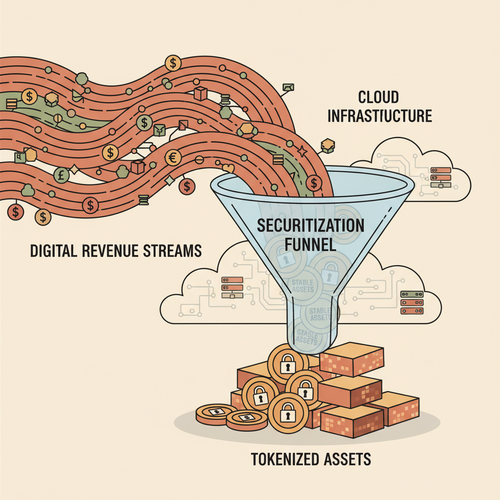
The securitization process begins with asset origination. A pool of qualified digital revenue contracts forms the underlying asset. These assets are transferred to a Special Purpose Vehicle (SPV). The SPV is a separate legal entity. This legal separation isolates the assets from the originating company’s balance sheet. It protects investors from bankruptcy risks.
The SPV then issues interest-bearing notes to investors. These notes are backed by the future cash flows of the digital revenue. Credit enhancement mechanisms bolster investor confidence. These can include overcollateralization or reserve accounts. Rating agencies assess the credit quality of these notes. They assign ratings based on risk profiles. Different tranches cater to varying investor risk appetites. Senior tranches offer lower risk and yield. Junior tranches carry higher risk but greater potential returns. Legal frameworks ensure robust enforceability of contracts. Regulatory compliance is paramount for market acceptance. Securitization transforms illiquid assets into liquid securities.
Leveraging Distributed Ledger Technology (DLT) for Enhanced Securitization
Distributed Ledger Technology (DLT) revolutionizes securitization. It offers unprecedented transparency and efficiency. Digital revenue streams can be tokenized. Each token represents a fractional ownership interest in the revenue pool. This allows for granular investment opportunities.
Smart contracts automate the entire process. They manage revenue collection and distribution. Investor payments become automatic and transparent. This significantly reduces administrative overhead. It also minimizes human error and potential fraud. Fractional ownership democratizes access to these investments. Smaller investors can participate in previously exclusive markets. DLT also provides an immutable audit trail. This fosters trust among all stakeholders. The reduction in intermediaries lowers transaction costs. Increased liquidity becomes a key benefit of tokenized assets. Asset-backed securities, enhanced by DLT, represent a new frontier.
Risk Mitigation and Due Diligence in Securitizing SaaS Revenue
Securitizing SaaS revenue involves distinct risk profiles. Operational risk stems from service delivery failures. These failures can impact subscription renewals. Credit risk relates to customer default on payments. Market risk involves shifts in demand or competitive pressures. Diligent revenue predictability models are essential. These models account for churn rates and expansion revenue. Robust stress testing scenarios evaluate portfolio resilience. They project performance under adverse economic conditions.
Legal and regulatory risks demand constant vigilance. Data privacy concerns, like GDPR or CCPA, are critical. Any breach can severely impact reputation and revenue. The quality of the servicer, managing the revenue collection, is paramount. Comprehensive due diligence evaluates the underlying contracts. It also assesses the technological infrastructure. Strong governance frameworks provide investor confidence. These measures collectively safeguard investment capital. Effective risk stratification optimizes portfolio performance. Investors demand clarity on these intricate factors.
Strategic Advantages and Global Market Implications
Securitizing digital revenue offers compelling strategic advantages. It provides access to a broader institutional investor base. This lowers the effective cost of capital for SaaS firms. Balance sheet optimization improves financial ratios. It frees up conventional credit lines for operational needs. Expansion capital can be raised efficiently. This fuels aggressive market penetration strategies. Strategic partnerships also become more accessible.
The development of secondary markets for these instruments is nascent. However, DLT accelerates this evolution. It promises enhanced liquidity for investors. This creates a more dynamic ecosystem for digital asset trading. Securitization fosters disintermediation in financing. Companies gain greater control over their funding strategies. Global digital revenue, once considered intangible, becomes a tangible asset class. This paradigm shift redefines corporate finance. It unlocks trillions in previously inaccessible capital. This fuels innovation across diverse sectors.
Conclusion
The convergence of scalable SaaS architectures and financial engineering is transformative. It unlocks unprecedented capital for digital enterprises. Securitizing predictable digital revenue streams provides robust funding solutions. These methods circumvent traditional equity dilution. DLT integrations elevate efficiency, transparency, and liquidity. Investors gain access to a novel asset class with compelling yields. Rigorous due diligence remains crucial for risk mitigation. The future of capital formation is undeniably digital. Will your organization capitalize on this profound financial evolution?