Executive Summary
- Monetary policy profoundly shapes fixed income valuations and market dynamics.
- Understanding transmission mechanisms is critical for anticipating market shifts and interest rate volatility.
- Sophisticated hedging strategies are indispensable for mitigating duration, credit, and basis risks in bond portfolios.
Unpacking Monetary Policy: Beyond the Headlines
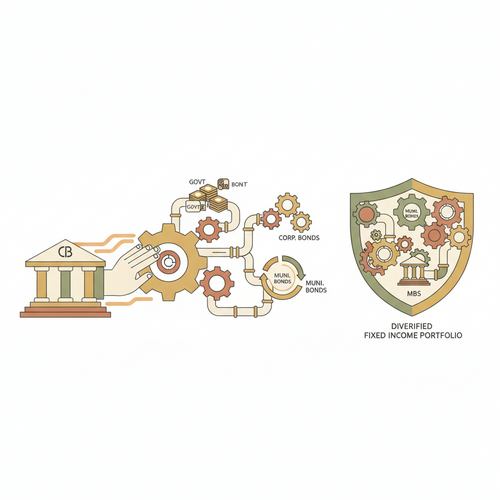
Central banks globally wield significant power. Their actions directly influence economic activity and financial market conditions. These influences are not arbitrary but follow established transmission mechanisms.
Monetary policy, at its core, involves managing the money supply. This management aims to achieve price stability and maximum sustainable employment. Understanding these dynamics is crucial for every fixed income investor.
Key tools include adjusting policy rates and conducting open market operations. Quantitative easing (QE) and quantitative tightening (QT) represent more recent, unconventional interventions. These tools collectively steer the economy.
The Interest Rate Channel: Direct and Potent
The interest rate channel is perhaps the most direct mechanism. Central bank policy rate adjustments immediately impact short-term borrowing costs. This effect quickly cascades through the financial system.
Changes in the overnight lending rate influence the entire yield curve. Shorter-term bonds react almost instantaneously. Longer-term yields reflect market expectations of future policy and inflation.
Higher rates increase the cost of capital for businesses. This dampens investment and consumer spending. Conversely, lower rates stimulate economic activity through cheaper credit access.
Credit Channel Dynamics: Lending and Investment Implications
Beyond direct rates, the credit channel operates through lending conditions. Central bank actions affect banks’ balance sheets. This influences their capacity and willingness to lend.
The bank lending channel suggests that tighter policy restricts loan availability. This occurs irrespective of demand. Banks face higher funding costs and stricter capital requirements.
The balance sheet channel impacts borrowers directly. Asset prices fall with higher rates. This reduces the value of collateral. It also increases debt burdens, affecting corporate net worth and household wealth.
Reduced net worth makes borrowing more expensive. It can even prevent access to credit. This mechanism profoundly affects investment and consumption decisions.
Exchange Rate Channel and International Capital Flows
Monetary policy also profoundly influences exchange rates. A higher domestic interest rate attracts foreign capital. This strengthens the domestic currency.
A stronger currency makes imports cheaper and exports more expensive. This can impact a nation’s trade balance. It also affects the competitiveness of domestic industries.
For international fixed income investors, exchange rate fluctuations introduce significant currency risk. Hedging this exposure becomes a critical component of portfolio management. Global fixed income allocations must account for these currency dynamics.
Asset Price Channel: Wealth Effects and Market Sentiment
Monetary policy significantly impacts asset valuations. Lower interest rates typically boost equity and real estate prices. Investors seek higher returns in riskier assets.
This rise in asset values creates a “wealth effect.” Households feel richer and tend to increase consumption. This stimulates economic growth.
Conversely, tightening policy can deflate asset bubbles. It reduces speculative activity. This shift can lead to reduced consumption and investment. Market sentiment often pivots on these central bank signals.
Inflation Expectations and Forward Guidance
Central bank credibility is paramount for managing inflation expectations. Credible monetary policy anchors long-term interest rates. It prevents destabilizing inflationary or deflationary spirals.
Forward guidance provides transparency on future policy intentions. This helps markets anticipate changes. It reduces uncertainty and influences long-term yield formation.
Unanchored inflation expectations can undermine policy effectiveness. This makes fixed income investing particularly challenging. Real returns become highly volatile under such conditions.
Expert Insight: “In analyzing recent market shifts, we observe a nuanced interplay between central bank forward guidance and investor reaction. The market’s interpretation of ‘transitory’ inflation, for instance, dramatically influenced bond market positioning.”
Navigating Volatility: Fixed Income Hedging Imperatives
Fixed income investors face numerous risks stemming from monetary policy. Interest rate risk, specifically duration risk, is paramount. Rising rates can significantly erode bond portfolio values.
Credit risk also remains a persistent concern. Economic downturns, often triggered or exacerbated by policy shifts, increase default probabilities. Spread widening is a common manifestation.
Basis risk arises when the hedging instrument does not perfectly track the hedged asset. This imperfect correlation can leave residual exposure. Understanding these nuances is vital for effective risk management.
Convexity measures the sensitivity of duration to interest rate changes. Positive convexity is generally desirable. It offers greater price appreciation when yields fall and less depreciation when yields rise.
Advanced Hedging Strategies: Precision in a Dynamic Market
Sophisticated investors employ various derivatives for fixed income hedging. Interest rate swaps (IRS) are a cornerstone. They convert floating-rate exposure to fixed, or vice versa.
Treasury futures and options provide effective tools for duration management. Futures contracts allow for price speculation or hedging. Options offer more tailored risk-reward profiles.
Credit default swaps (CDS) can hedge specific credit exposures. They provide protection against issuer default. This is especially useful for managing corporate bond portfolios.
- Interest Rate Swaps: Custom instruments to manage future interest rate payments.
- Bond Futures: Standardized contracts for hedging benchmark government bond exposures.
- Options on Futures: Provide flexibility, allowing participation in favorable movements while limiting downside.
- Credit Default Swaps: Transfer credit risk from one party to another for a premium.
Portfolio-level hedging requires a holistic approach. It considers correlations between different assets. It also assesses the overall risk-return objectives. Dynamic adjustments are often necessary.
Conclusion
Monetary policy transmission mechanisms are the bedrock of financial market understanding. Their influence on fixed income markets is undeniable. Investors must grasp these intricate relationships.
Proactive and sophisticated hedging strategies are not optional. They are critical for preserving capital and generating alpha. Navigating interest rate volatility demands precision and foresight.
Are your fixed income portfolios sufficiently prepared for the next wave of central bank action?