Introduction
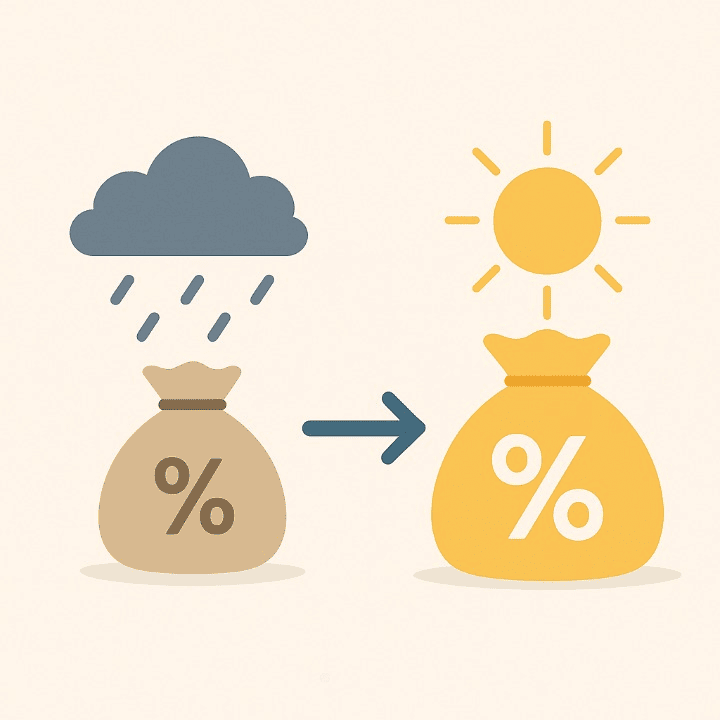
Saving money is one of the most important habits for a healthy financial life. It is a fantastic first step toward building security and achieving your goals. However, where you decide to save your money matters immensely. Many people simply keep their savings in a traditional savings account at a large bank. Unfortunately, these accounts often pay a very low interest rate. As a result, your money is barely growing, if at all.
This means you are missing out on an opportunity to make your money work for you. This guide will explore two powerful tools designed to help you earn a much higher interest rate. These are the High-Yield Savings Account (HYSA) and the Certificate of Deposit (CD). Understanding how they work, and the differences between them, is a key step to boosting your savings and accelerating your journey toward better financial health.
The Problem with Traditional Savings Accounts
Before we explore the better options, let’s understand the issue with standard savings accounts. Their primary feature is safety. However, their main drawback is an extremely low Annual Percentage Yield (APY), which is the interest you earn in a year.
The biggest enemy of stagnant cash is inflation. Inflation is the rate at which the general level of prices for goods and services is rising. This means your purchasing power is falling. If your savings account is paying a 0.1% interest rate, but inflation is at 3%, your money is actually losing 2.9% of its value every year. In short, you are getting poorer just by leaving your money in the wrong place.
Deep Dive: The High-Yield Savings Account (HYSA)
A high-yield savings account, or HYSA, is a simple and powerful alternative. It is a savings account that offers a much higher interest rate than a standard one. The difference can be substantial. For instance, an HYSA might offer a rate that is 10 or even 20 times higher than a traditional account.
You might wonder how this is possible. HYSAs are typically offered by online banks. These banks have much lower overhead costs. For example, they do not have to pay for physical branches or a large staff of tellers. They pass these savings on to their customers in the form of a higher interest rate.
Key Features of an HYSA
- High APY: This is the main attraction and the reason you choose this account. It allows your money to grow much faster.
- Liquidity: This is a very important feature. Your money in an HYSA is liquid. This means you can access it easily and quickly when you need it, without penalty. This makes HYSAs the perfect place to store your emergency fund. An emergency fund is the best form of self-insurance against unexpected financial shocks.
- Variable Rate: You should be aware that the interest rate on an HYSA is variable. This means it can change over time. The rate may move up or down as the central bank adjusts its own rates.
The best use for an HYSA is for your emergency fund and any other short-term savings goals where you need easy access to your cash.
Deep Dive: The Certificate of Deposit (CD)
Next, we have another excellent savings tool: the Certificate of Deposit, or CD. A CD is a savings product where you agree to leave your money with a bank for a specific, predetermined period of time. This is known as the “term.” CD terms can range from a few months to several years.
The core of a CD is a trade-off. In exchange for you agreeing to lock up your money for the term, the bank gives you a fixed interest rate. This rate is often even higher than what an HYSA offers at that moment.
Key Features of a CD
- Fixed APY: Your interest rate is guaranteed for the entire term. This provides certainty and protects you if market interest rates fall.
- Lack of Liquidity: This is the main drawback. If you need to withdraw your money before the CD’s term ends, you will almost always have to pay an early withdrawal penalty. This penalty is often equal to several months of interest.
- Specific Term: You choose the length of time your money is locked in. Common terms include 6 months, 1 year, or 5 years.
A CD is ideal for savings goals that have a specific deadline. For example, if you know you want to buy a house in two years, a 2-year CD can be a perfect place to save your down payment. You know you will not need the money before then, and you get a guaranteed return. This is a key step to securing your future financing.
HYSA vs. CD: A Head-to-Head Comparison
So, how do you choose between these two excellent options? Let’s compare them directly.
For Flexibility and Access: The HYSA is the clear winner. Its liquidity makes it the superior choice for any money you might need to access unexpectedly.
For Rate Certainty: The CD is the winner here. Its fixed rate is locked in. This is a great benefit if you are worried that interest rates might go down in the future.
For Potential Returns: This depends on the market. Sometimes, CD rates are higher. At other times, HYSA rates might be more competitive. You need to compare the current offers.
Here is a simple way to decide. If you are building your emergency fund, use an HYSA. If you are saving for a specific goal with a fixed timeline (like a wedding in 18 months), a CD is a great choice. It is important to remember that neither of these tools is meant for paying off debt. You should always prioritize paying off high-interest debt, like a credit card balance, before focusing heavily on saving.
The Big Picture: How These Tools Build Your Future
Using these tools does more than just earn you a little extra interest. It builds strong financial habits. Consistently putting money into an HYSA or a CD shows financial discipline. Furthermore, building a substantial savings balance improves your overall financial stability. This makes you a much more attractive and lower-risk candidate in the eyes of lenders. As a result, it can have a positive impact on your credit profile and help you get better terms on loans in the future.
Conclusion
In conclusion, you should not let your hard-earned savings sit in a traditional account that earns next to nothing. You have the power to make your money work much harder for you. By understanding the tools available, you can significantly accelerate your progress toward your financial goals.
We have seen that HYSAs and CDs each have a specific role to play. HYSAs are perfect for liquid savings, most notably your emergency fund. CDs, on the other hand, are great for goals with a fixed timeline where you want a guaranteed return.
Choosing the right savings vehicle is a simple but powerful step. It is an action you can take today to improve your long-term financial health and build your wealth more effectively.