Introduction
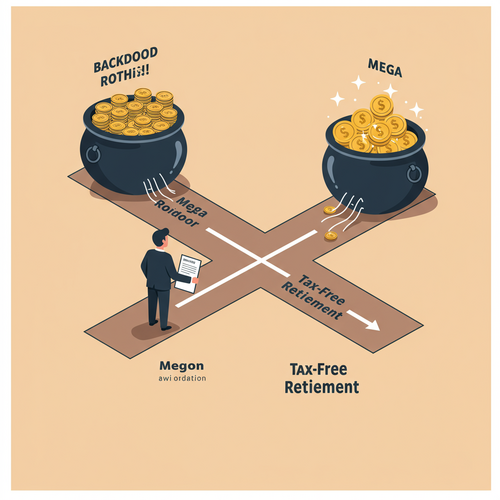
For many investors, a Roth IRA represents the pinnacle of retirement savings. Imagine contributing to an account, watching your investments grow completely tax-free, and then withdrawing all that money in retirement without owing a single cent to the IRS. This dream scenario is a reality for Roth IRA holders, offering unparalleled tax advantages—especially for long-term wealth building. This guide will focus on the **Backdoor Roth IRA vs. Mega Backdoor Roth** strategies, which are vital for high earners.
However, the path to Roth IRA benefits isn’t straightforward for everyone. High-income earners often find themselves excluded from direct Roth IRA contributions due to strict IRS income limits. This exclusion can be frustrating, as it prevents access to one of the most effective tools for tax-efficient retirement planning.
The good news: there are strategies to overcome this barrier. Two of the most effective are the Backdoor Roth IRA and the Mega Backdoor Roth. This guide explains how both methods work, what their requirements are, and how they can help high earners legally and strategically move funds into Roth accounts for tax-free growth and withdrawals. Understanding these techniques is key to optimizing retirement savings and maximizing financial freedom.
Understanding the Roth IRA Advantage
Why Roth? Tax-Free Growth and Withdrawals
A Roth IRA stands out because of its unique tax treatment. Contributions are made with after-tax dollars, meaning you won’t get a tax deduction now—but every qualified withdrawal in retirement, including growth, is completely tax-free. This is a massive benefit compared to traditional, tax-deferred accounts where every dollar you withdraw is taxed as ordinary income.
This structure differs from traditional IRAs and 401(k)s, where contributions are tax-deductible but withdrawals are fully taxed. For investors expecting to be in the same or higher tax brackets in retirement (due to success, inflation, or future tax hikes), a Roth provides long-term predictability and control. You are essentially “paying” the taxes today to “buy” a tax-free future.
Another major benefit is flexibility. You can withdraw your direct contributions (not earnings) at any time, for any reason, without taxes or penalties. This makes the Roth IRA not only a vehicle for retirement growth but also a potential emergency fund if needed. The mix of tax-free growth, predictability, and liquidity makes it a cornerstone of intelligent retirement planning.
Income Limits: Who Can Contribute Directly?
Despite its advantages, not everyone qualifies for direct Roth contributions. The IRS imposes annual income limits based on Modified Adjusted Gross Income (MAGI). These limits are adjusted annually for inflation.
For example, for tax year **2025** (which you file in 2026):
- Single filers: The ability to contribute is phased out for those with a MAGI between $151,000 and $166,000. If you earn over $166,000, you cannot contribute directly.
- Married couples filing jointly: The phase-out range is between $234,000 and $246,000. If your joint income exceeds $246,000, direct contributions are disallowed.
These limits are designed to target middle-income savers but unintentionally exclude many successful professionals. That’s where the **Backdoor Roth IRA vs. Mega Backdoor Roth** strategies come into play—they bypass these restrictions legally and efficiently.
The Backdoor Roth IRA Strategy
What Is a Backdoor Roth IRA?
The Backdoor Roth IRA allows high-income earners to access Roth benefits indirectly. It isn’t a special account but a two-step process that uses existing IRA rules to “convert” funds into a Roth. It is a simple, elegant workaround for the income limits.
You contribute to a Traditional IRA (which has no income limit for non-deductible contributions), then convert that balance to a Roth IRA. Since Roth conversions themselves have no income cap, this method effectively opens a “backdoor” for high earners to participate in Roth savings. This tactic became popular after 2010, when income restrictions on Roth conversions were removed.
How to Execute a Backdoor Roth (Step-by-Step)
The process is straightforward, but must be done precisely:
- Contribute to a Non-Deductible Traditional IRA.
You open or use an existing Traditional IRA and contribute up to the annual limit. For 2025, this is $7,000 (or $8,000 if you are age 50 or older). Since your income is high, you cannot deduct this contribution on your taxes, making it “non-deductible.” - Convert the Traditional IRA to a Roth IRA.
Soon after contributing—usually within a few days to avoid accruing interest—you file paperwork with your brokerage to “convert” the entire balance of the Traditional IRA to a Roth IRA. - Pay Taxes (If Any).
If you only have non-deductible funds in your Traditional IRA, the conversion itself is generally tax-free. You’ve already paid taxes on that money. You would only owe tax on any small gains that occurred between contribution and conversion (which is why you do it quickly). - Report on IRS Form 8606.
This is a critical step. You must file IRS Form 8606 with your tax return. This form documents your non-deductible contributions and tracks your “basis” to ensure you are not double-taxed on the conversion. Accurate reporting is essential.
The Critical Pitfall: The Pro-Rata Rule
The Backdoor Roth IRA strategy works perfectly *only if* you have no other pre-tax IRA funds. If you have existing Traditional, SEP, or SIMPLE IRAs with pre-tax (deducted) contributions, you will face the **Pro-Rata Rule**.
The IRS requires you to aggregate *all* your IRA balances (Traditional, SEP, SIMPLE) when calculating the tax on a conversion. It does not let you cherry-pick only the non-deductible funds. For example:
- You have $93,000 in an old pre-tax Rollover IRA.
- You contribute $7,000 in new, non-deductible funds to a separate Traditional IRA, bringing your total IRA balance to $100,000.
- You convert the $7,000 to a Roth IRA.
The IRS sees that only 7% ($7,000 / $100,000) of your total IRA balance is after-tax. Therefore, only 7% of your conversion ($490) is tax-free. The other 93% ($6,510) is considered a pre-tax conversion and is **fully taxable as ordinary income**. This defeats the purpose of the strategy. The best solution is to roll any existing pre-tax IRA balances into your current employer’s 401(k) (if the plan allows), which removes them from the pro-rata calculation.
Pros and Cons of a Backdoor Roth
- Pros: Enables high earners to access Roth benefits despite income limits. It offers tax-free growth and withdrawals once funds are in the Roth. Plus, Roth IRAs have no Required Minimum Distributions (RMDs) during the owner’s lifetime.
- Cons: The main ‘con’ in the **Backdoor Roth IRA vs. Mega Backdoor Roth** comparison is the Pro-Rata Rule. It can be a major tax trap if you have existing pre-tax IRAs. The contribution limits are also relatively low.
The Mega Backdoor Roth Strategy
What Makes It “Mega”?
The Mega Backdoor Roth goes far beyond the standard Roth limits. It uses an employer’s 401(k) plan to move significantly larger sums into Roth accounts. The total IRS limit for all 401(k) contributions (employee, employer, and after-tax) in 2025 is $73,500 (or $81,000 for those 50+).
It works by making *after-tax contributions* to your 401(k) and then rolling or converting those funds into a Roth IRA or Roth 401(k). This allows far greater Roth funding than any individual IRA limit would permit. This massive contribution potential is the single biggest difference when comparing the **Backdoor Roth IRA vs. Mega Backdoor Roth**.
Steps to Execute a Mega Backdoor Roth
- Max Out Regular 401(k) Contributions.
First, you must contribute the maximum employee deferral. For 2025, this is $23,500 (or $31,000 if 50+). These can be pre-tax or Roth 401(k) contributions. - Add After-Tax Contributions.
This is the key. After maxing out your employee contribution, you make *additional* non-Roth, after-tax contributions up to the total $73,500 limit. For example: $73,500 (Total Limit) – $23,500 (Your Contribution) – $10,000 (Employer Match) = **$40,000** in “space” for after-tax contributions. - Convert Quickly.
You then immediately convert those after-tax contributions. Your plan will allow one of two things: an “in-service rollover” to an external Roth IRA, or an “in-plan Roth conversion” to your Roth 401(k). Acting fast minimizes any taxable earnings.
Key Requirements and Considerations
This strategy is powerful, but it is entirely dependent on your employer’s 401(k) plan. To use this strategy, your plan must allow **both** of the following:
- Allow After-Tax Contributions: This is *not* the same as a Roth 401(k) contribution. It is a separate, less common feature. You must check your “Summary Plan Description” or call your 401(k) provider to see if this is offered.
- Permit In-Service Rollovers or In-Plan Roth Conversions: The plan must allow you to move those after-tax dollars *while you are still an employee*. If it only allows after-tax contributions but no in-service conversions, your after-tax money will be “trapped” until you leave the employer, and all its earnings will be tax-deferred (taxable upon withdrawal), which defeats the purpose.
Because of its complexity and large amounts involved, coordination with your HR