Introduction
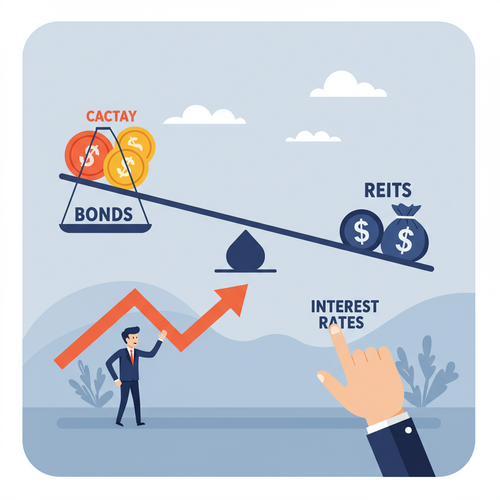
Understanding the intricate dance between interest rates and your investments is crucial. For many, the rising interest rates bond REIT impact is a primary concern. This is especially true for those holding fixed-income assets and real estate. When central banks adjust interest rates, a ripple effect touches every corner of the financial market. For investors, grasping these dynamics is not just academic. In fact, it directly influences portfolio performance and strategic decisions.
Interest rate changes are often a response to broader economic conditions. They can signal shifts in inflation or economic growth. Therefore, knowing how these changes affect your holdings is paramount. This article will thoroughly explore the relationship between rising interest rates and both bond portfolios and REIT investments. Additionally, we will provide actionable strategies for navigating these challenging environments.
Understanding the Rising Interest Rates Bond REIT Impact
Interest rates are a fundamental pricing mechanism in finance. They represent the cost of borrowing money. They also reflect the return for lending it. These rates are set by various factors, but central bank policies play a dominant role.
The Role of Central Banks and Monetary Policy
Central banks, like the U.S. Federal Reserve, are responsible for maintaining economic stability. They achieve this through monetary policy. One of their primary tools is setting benchmark interest rates. For instance, the Federal Reserve influences the federal funds rate. This rate, in turn, affects other interest rates throughout the economy.
When inflation rises too quickly, central banks often increase interest rates. This makes borrowing more expensive. It also discourages spending and investment. The goal is to cool down the economy and bring inflation back under control. Conversely, during economic downturns, central banks may lower rates. This stimulates borrowing and economic activity. Such decisions have wide-ranging implications for all asset classes, especially bonds and real estate.
Inflation, Rates, and Investor Expectations
A primary driver for central banks to raise interest rates is to combat high inflation. Inflation erodes the purchasing power of future bond payments, making fixed-income investments less attractive. By raising rates, central banks make borrowing more expensive, which cools down economic demand and, in theory, tames inflation. For investors, this relationship is a double-edged sword. While rising rates hurt existing bond prices, they are often a necessary medicine to protect the long-term value of currency and stabilize the economy. Furthermore, investor *expectations* of future rate hikes can move markets even before the central bank acts. This “forward guidance” can cause bond yields to rise preemptively, meaning the market often prices in changes before the policy is official.
Why Interest Rates Matter to Investors
For investors, interest rates are more than just numbers. They are a critical determinant of asset valuations. Higher rates can increase the cost of capital for businesses. They can also make future earnings less attractive when discounted to present value. For fixed-income investors, the reality of rising interest rates eroding the value of existing holdings is a primary concern. This is because newer instruments offer more appealing returns. Understanding this connection is the first step toward building a resilient portfolio.
The Impact of Rising Rates on Your Bond Portfolio
Bonds are a cornerstone of many diversified portfolios. They are often valued for their stability and income-generating potential. However, rising interest rates present a specific challenge to these fixed-income assets. Grasping this relationship is vital for bond investors.
Bonds 101: The Basics of Fixed Income
A bond is essentially a loan made by an investor to a borrower. This could be a corporation or a government. When you buy a bond, you are lending money. In return, the issuer promises to pay you regular interest payments (the coupon rate). They also promise to return your principal at a specified future date (the maturity date).
Bonds are considered “fixed income” because their payments are generally predetermined. This predictability is often attractive to investors seeking stable returns. They can also offer a counterbalance to more volatile assets like stocks. However, their fixed nature also makes them sensitive to interest rate fluctuations. This sensitivity is precisely why their value changes when rates move.
Inverse Relationship: Bond Prices and Yields
One of the most fundamental principles in the bond market is the inverse relationship between bond prices and interest rates (or yields). When market interest rates rise, the value of existing bonds with lower coupon rates typically falls. This happens because newly issued bonds offer higher yields. As a result, older bonds become less attractive by comparison.
Consider a bond issued when market rates were 3%. If new bonds are now being issued with a 5% yield, no one will pay full price for the old 3% bond. Its market price must drop until its effective yield matches the prevailing market rates. This adjustment ensures that the older bond becomes competitive. This phenomenon is critical for investors to understand. It means that if you need to sell your bonds before maturity in a rising rate environment, you might face a capital loss.
Duration and Its Significance: A Key Factor in Bond Risk
Duration is a key measure of a bond’s sensitivity to interest rate changes. It is expressed in years. A bond with a longer duration will experience a larger price change for a given change in interest rates. Conversely, a bond with a shorter duration will be less sensitive. For example, a bond with a duration of 7 years will likely fall in value by approximately 7% if interest rates rise by 1%.
This concept is extremely important for managing bond portfolios. The full rising interest rates bond REIT impact is most visible here. In a rising interest rate environment, investors often prefer bonds with shorter durations. These bonds offer more protection against price declines. Consequently, understanding your portfolio’s average duration can help you assess its risk to interest rate movements.
Strategies for Bond Investors in Rising Rate Environments
Navigating a period of rising interest rates requires thoughtful strategies. Here are some approaches bond investors can consider to mitigate risk:
- Short-Duration Bonds: Shifting towards bonds with shorter maturities and, therefore, shorter durations can mitigate price risk. These bonds re-price more quickly to new, higher rates. This allows investors to reinvest at more favorable yields sooner.
- Bond Ladders: A bond ladder involves investing in bonds with staggered maturity dates. For example, you might buy bonds maturing in 1, 2, 3, 4, and 5 years. As each bond matures, you reinvest the principal into a new, longer-term bond at the prevailing higher rates. This strategy helps smooth out interest rate risk and provides continuous cash flow.
- Floating-Rate Bonds: These bonds have coupon rates that adjust periodically based on a benchmark interest rate (e.g., SOFR). As interest rates rise, the coupon payments on floating-rate bonds also increase. This helps to protect the investor from the typical price declines experienced by fixed-rate bonds.
- Inflation-Protected Securities (TIPS): While not directly addressing rising nominal rates, TIPS protect against inflation. Their principal value adjusts with inflation, and the coupon payments are then paid on the adjusted principal. In an environment where rising rates are driven by inflation, TIPS can offer a valuable hedge.
- Active vs. Passive Management: In a rising rate environment, an actively managed bond fund may offer advantages. Fund managers can proactively adjust the portfolio’s duration and credit quality, potentially navigating the market more nimbly than a passive index fund, which must simply track its underlying index regardless of rate movements.
For more detailed strategies, resources like Investopedia offer comprehensive guidance on managing bond portfolios when rates are on the rise. Diversification within your fixed-income allocation is always a prudent approach.
How Rising Rates Affect REIT Investments
Real Estate Investment Trusts (REITs) offer investors a way to participate in the real estate market. They do so without directly owning physical properties. REITs often provide attractive dividend yields. This makes them popular among income-focused investors. However, like bonds, they are also sensitive to interest rate changes.
REITs Explained: Real Estate Investment Trusts
REITs are companies that own, operate, or finance income-producing real estate. They specialize in various property types, such as apartments, shopping centers, offices, hotels, and data centers. To qualify as a REIT, a company must distribute at least 90% of its taxable income to shareholders annually. This structure allows them to avoid corporate income tax. In return, they offer investors a share in the rental income and property appreciation, which often comes with high dividend payouts.
Investing in REITs provides liquidity. You can buy and sell shares on stock exchanges, unlike direct property ownership. They also offer diversification and professional management. However, their performance can be closely tied to the broader economic environment and interest rate movements.
Debt and Borrowing Costs for REITs
Real estate is a capital-intensive business. Consequently, REITs heavily rely on debt to acquire and develop properties. They also use debt for ongoing operations. When interest rates rise, the cost of borrowing for REITs increases. This aspect of the rising interest rates bond REIT impact can affect profitability in several ways:
- Higher Interest Expenses: Existing variable-rate debt becomes more expensive. New debt for acquisitions or refinancing also carries higher interest costs. This directly reduces a REIT’s net income.
- Reduced Development and Acquisitions: Higher borrowing costs can make new property developments less economically viable. They also make new acquisitions less attractive. This can slow down a REIT’s growth trajectory.
- Lower Funds From Operations (FFO): FFO is a key metric for REITs. It measures their cash flow from operations. Increased interest expenses can depress FFO. This may lead to lower dividends or slower dividend growth.
The extent of this impact depends on a REIT’s debt structure. For instance, REITs with less debt or a higher proportion of fixed-rate debt might be more resilient. In contrast, those with significant variable-rate debt are more vulnerable. Prudent REIT management teams often use interest rate swaps or lock in fixed-rate debt for long terms to mitigate this risk, but investors must check the balance sheet.
Cap Rates and Property Valuations
Capitalization rates (Cap Rates) are another crucial factor. They are used to value income-producing properties. A cap rate is the ratio of a property’s net operating income (NOI) to its market value. In simple terms, it represents the unlevered yield on a property.
Cap rates tend to move in tandem with interest rates. When interest rates rise, investors typically demand higher returns on their real estate investments. This, in turn, pushes cap rates higher. For a property with a fixed net operating income, a higher cap rate implies a lower property valuation. This direct relationship means that rising interest rates can lead to a decrease in the underlying value of the properties held by REITs. Consequently, this can negatively affect their share prices.
REITs as an Alternative to Fixed Income
Historically, REITs have often been viewed as an alternative to fixed-income investments due to their high dividend yields. When interest rates are low, the attractive yields of REITs stand out. However, as interest rates rise, the fixed-income market begins to offer more competitive yields. This can draw investors away from REITs and back into bonds. This shift in investor preference can put downward pressure on REIT share prices. As a result, investors might opt for less volatile bond investments when bond yields become more appealing. This investor rotation is a key component of the rising interest rates bond REIT impact.
Specific REIT Sectors and Rate Sensitivity
Not all REIT sectors are equally sensitive to interest rate changes. Some sectors may demonstrate greater resilience or even benefit from certain economic conditions associated with rising rates:
- Residential REITs: These can be sensitive, but strong rental demand in certain markets can offset some of the rate impact, especially if they can raise rents to keep pace with inflation.
- Industrial REITs: Often driven by e-commerce growth, demand for logistics properties can remain strong even with rising rates. Long-term leases can provide stable cash flow.
- Healthcare REITs: Demographic trends, such as an aging population, can provide a stable demand for healthcare facilities, making these REITs potentially more defensive.
- Data Center REITs: Benefiting from digital transformation, these REITs often have long-term leases with high-quality tenants, providing a high degree of stability.
- Office and Retail REITs: These sectors face dual headwinds. Not only do rising rates increase borrowing costs, but they often accompany economic slowdowns that can reduce demand for office space (compounded by remote work trends) and retail locations. Investors must scrutinize tenant quality and lease durations in these sectors.
Understanding the specific characteristics of different REIT sectors is important. It helps in making informed investment decisions. For more insights on how various REIT types perform, NAREIT (National Association of Real Estate Investment Trusts) provides valuable information on REIT performance in diverse interest rate environments.
Diversification and Portfolio Management Strategies
In any economic climate, thoughtful portfolio management is key. This is especially true when interest rates are in flux. Diversification remains a powerful tool for mitigating risk.
The Importance of a Balanced Approach
A balanced portfolio aims to spread investments across various asset classes. This includes stocks, bonds, real estate, and commodities. The goal is to reduce overall risk and manage the rising interest rates bond REIT impact across your entire net worth. While rising rates can challenge bonds and REITs, other parts of your portfolio might perform differently. For example, certain equity sectors (like financials) might thrive in an inflationary, rising-rate environment.
Regularly rebalancing your portfolio ensures that your asset allocation aligns with your risk tolerance. It also matches your financial goals. This disciplined approach prevents any single asset class from dominating your portfolio unexpectedly.
The Role of Cash and Equivalents
In a rising rate environment, “cash” is no longer trash. As interest rates climb, the yields on cash-equivalent investments like high-yield savings accounts (HYSAs) and money market funds (MMFs) become much more attractive. Holding a portion of your portfolio in cash serves two purposes. First, it acts as a “dry powder,” allowing you to buy assets like bonds or REITs after their prices have fallen. Second, it provides a safe, appreciating (in nominal terms) haven that is completely insulated from the price risk affecting your bond portfolio. This strategic allocation to cash can be a powerful tool for portfolio management during a rate-hike cycle.
Considering Other Asset Classes
When bonds and REITs face pressure from rising rates, it may be time to assess other investment opportunities. Equities can offer growth potential. Certain sectors, such as financials or value stocks, can sometimes perform well in a rising rate environment. Commodities, like gold or oil, can also act as an inflation hedge. Cash and short-term money market funds become more attractive as their yields increase, providing a safe haven and liquidity.
However, each asset class comes with its own set of risks and rewards. A thorough understanding of your investment horizon and risk appetite is essential before making any shifts.
Seeking Professional Advice
Navigating complex financial markets, particularly during periods of significant change, can be daunting. Engaging with a qualified financial advisor can provide immense value. An advisor can help you:
- Assess your current portfolio’s exposure to interest rate risk.
- Develop tailored strategies to adapt to changing market conditions.
- Ensure your investment decisions align with your long-term financial objectives.
- Provide an unbiased perspective and help you avoid emotional investing.
They bring expertise and experience. This can be invaluable in making informed choices and maintaining peace of mind. Investing in your financial education and seeking expert guidance are both strong strategies for success.
Conclusion
Rising interest rates undoubtedly create headwinds for both fixed-income and real estate assets. Bonds typically see their prices fall as new bonds offer higher yields, with longer-duration bonds being the most sensitive. For REITs, higher borrowing costs and increasing capitalization rates can depress property valuations and ultimately impact profitability and share prices. Clearly, the full rising interest rates bond REIT impact is a critical factor to manage.
However, this challenging environment also presents opportunities for astute investors. By understanding the inverse relationship between bond prices and yields, the concept of duration, and the unique sensitivities of various REIT sectors, you can make informed adjustments. Strategies such as focusing on short-duration bonds, implementing bond ladders, or exploring specific REIT sectors that are more resilient can help mitigate risks. Ultimately, a well-diversified portfolio, regular rebalancing, and a willingness to adapt your investment approach are crucial for successfully navigating periods of rising interest rates. Staying informed and seeking professional guidance can empower you to protect and grow your wealth, no matter the economic climate.