Introduction
Navigating the world of retirement savings can feel like a complex puzzle. This is especially true for those with higher incomes. Many high earners quickly discover they exceed the income thresholds for contributing directly to a Roth IRA. This often leads to frustration, as the significant benefits of a Roth IRA – tax-free growth and tax-free withdrawals – seem out of reach. However, there is a powerful and legal strategy known as the Backdoor Roth IRA for high-income earners. This guide will demystify this essential financial maneuver. We will provide a clear roadmap to unlock the advantages of a Roth IRA. This article explores its mechanics, addresses common pitfalls, and ensures you understand how to implement it correctly to secure your financial future.
Understanding Roth IRAs and Income Limits
A Roth IRA is a cornerstone of retirement planning for many individuals. It stands out because contributions are made with after-tax dollars. This unique characteristic means your investments grow tax-free. Qualified withdrawals in retirement are also entirely tax-free. Imagine a future where every dollar you withdraw from your retirement account is yours, without Uncle Sam taking a cut. This benefit makes Roth IRAs incredibly attractive.
Beyond tax-free withdrawals, Roth IRAs offer flexibility. You can withdraw your contributions at any time, tax and penalty-free, if needed for emergencies. Furthermore, Roth IRAs have a major advantage over Traditional IRAs. They do not have a mandatory distribution age (RMDs) during the original owner’s lifetime. This offers more control over your legacy planning.
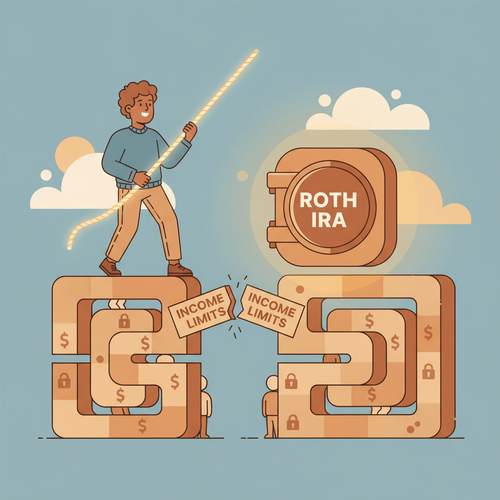
However, the Internal Revenue Service (IRS) imposes income limitations. These limits determine who can contribute directly to a Roth IRA. For instance, in 2024, the IRS sets specific modified adjusted gross income (MAGI) thresholds. If your income exceeds $161,000 (for single filers) or $240,000 (for married couples filing jointly), your ability to contribute is eliminated entirely. These limits can be a significant barrier for successful professionals and entrepreneurs. You can always check the latest thresholds directly on the IRS website for Roth IRA Contribution Limits.
These income restrictions force many high earners to seek alternative strategies. Consequently, the Backdoor Roth IRA becomes not just an option, but a necessity. It ensures that even those earning above the direct contribution limits can still access the long-term benefits of a Roth account. This makes understanding the Backdoor Roth IRA for high-income earners a critical financial step.
The Backdoor Roth IRA Strategy Explained
The Backdoor Roth IRA is a two-step process. It allows high-income individuals to effectively contribute to a Roth IRA, circumventing the direct income limitations. It is a legitimate and widely used strategy. This method involves using a Traditional IRA as a conduit to move funds into a Roth account.
Here’s how the strategy generally works:
- Step 1: Contribute to a Non-Deductible Traditional IRA. First, you contribute money to a Traditional IRA. For high-income earners, these contributions are typically non-deductible. This means you do not get a tax break on them. This is a crucial distinction.
- Step 2: Convert the Traditional IRA to a Roth IRA. Shortly after contributing, you convert the funds from your Traditional IRA into a Roth IRA. Since your initial contribution was non-deductible (after-tax money), this conversion is generally a tax-free event.
This “backdoor” approach works because of a specific quirk in the tax code. While there are income limits for *contributing* directly to a Roth IRA, there are no income limits for *converting* funds from a Traditional IRA to a Roth IRA. The IRS allows anyone, regardless of income, to perform a Roth conversion. You contribute to a non-deductible Traditional IRA. Then, you convert it. This process bypasses the direct contribution income limitations. This effectively “funnels” your after-tax savings into a Roth account. It allows them to grow and be withdrawn tax-free in retirement.
It is important to execute these steps carefully and understand the timing. Converting funds immediately after contribution minimizes the chance of any earnings accruing in the Traditional IRA. Those earnings could otherwise become taxable upon conversion. The goal is a seamless, tax-efficient transfer of after-tax money.
Navigating the Pro-Rata Rule and Aggregation
One of the most critical aspects of executing a Backdoor Roth IRA correctly is understanding and navigating the pro-rata rule. This rule can introduce unexpected tax liabilities if not managed properly. The IRS views all of your Traditional, SEP, and SIMPLE IRAs as one aggregated account for tax purposes. This means that when you convert funds from any Traditional IRA to a Roth IRA, the conversion is considered to be a proportional mix of all your pre-tax and after-tax IRA money. This calculation includes all your IRA accounts.
Here’s an example to illustrate. Suppose you have $94,000 in a pre-tax Traditional IRA from an old 401(k) rollover. You then contribute $6,000 to a new, non-deductible Traditional IRA, intending to convert it. Your total IRA balance is now $100,000. Of this, $94,000 is pre-tax and $6,000 is after-tax. If you convert only the $6,000 you just contributed, the IRS does not see it that way. It considers that $6,000 conversion to be 94% pre-tax ($5,640) and 6% after-tax ($360). Consequently, you would owe income taxes on the $5,640 portion of your conversion. This defeats the purpose of a tax-free backdoor Roth.
How to Avoid the Pro-Rata Rule
For a truly tax-free Backdoor Roth conversion, the ideal scenario is to have zero pre-tax money in any Traditional, SEP, or SIMPLE IRA accounts at the end of the year in which you perform the conversion. If you have existing pre-tax IRA balances, you have a few options to mitigate the pro-rata rule:
- Roll over pre-tax IRA funds into a 401(k). This is often the best solution. Many 401(k) plans accept rollovers from Traditional IRAs. Moving your pre-tax IRA money into a 401(k) effectively removes it from the IRA aggregation. 401(k) balances are not included in the pro-rata calculation. This “cleanses” your IRA accounts, allowing your non-deductible contribution to be converted tax-free.
- Convert all existing pre-tax IRA money to a Roth IRA. This is a viable option, but it comes with a cost. It will result in a significant taxable event in the year of conversion. All pre-tax converted funds become taxable income. For example, converting the $94,000 in the example above would add $94,000 to your income for the year. This is a large one-time tax bill, but it clears the way for all future Backdoor Roth IRA for high-income earners contributions to be tax-free.
The goal is to ensure that when you perform the conversion from a non-deductible Traditional IRA, there are no other pre-tax IRA funds to trigger the pro-rata rule. This ensures your conversion is entirely tax-free, reflecting the after-tax nature of your initial contribution.
The Mechanics of a Backdoor Roth Conversion
Executing a Backdoor Roth conversion involves careful steps and diligent record-keeping. It is not just about moving money. It is about proper tax documentation to avoid future headaches. Let’s break down the mechanics into distinct phases.
Step 1: Contribute to a Non-Deductible Traditional IRA
Your journey begins by contributing to a Traditional IRA. For high-income earners, this contribution will be non-deductible. This means you cannot claim a tax deduction for this money on your income tax return. You simply fund the account with after-tax dollars. The contribution limit for 2024 is $7,000 (or $8,000 if you’re age 50 or older).
First, choose a brokerage firm or financial institution that offers Traditional IRA accounts. You can often open this account online in minutes. Then, make your contribution. The key is *not* to claim the deduction on your tax return. This is what makes it “non-deductible.” Some people prefer to contribute to a brand new, empty Traditional IRA to keep the accounting clean, which is a highly recommended best practice. It is crucial to retain records of this contribution.
Step 2: Convert to a Roth IRA
Once your funds are in the Traditional IRA, the next step is to convert them to a Roth IRA. This conversion should ideally happen very soon after your initial contribution. A common question is how long to wait. There is no official IRS rule. However, many advisors suggest waiting a few days or until the funds have settled (e.g., 1-3 business days). This short, natural delay is generally accepted and avoids the appearance of a “step transaction” which the IRS could theoretically disallow.
Converting quickly minimizes the time your funds spend in the Traditional IRA. This reduces the chance for any investment gains to accumulate. If gains do accrue (even just a few dollars), those earnings would be taxable upon conversion. Your original non-deductible contribution would remain tax-free. Contact your brokerage to initiate a Roth conversion. This is often an option available through their online platform. You will specify that you want to convert the entire balance of your Traditional IRA to a Roth IRA. Remember, there are no income limitations for performing a Roth conversion.
Reporting the Backdoor Roth: Key Tax Forms
Accurate tax reporting is paramount for a successful Backdoor Roth IRA for high-income earners. This prevents the IRS from mistakenly taxing your after-tax contributions. You will interact primarily with two forms:
- Form 8606, Nondeductible IRAs: As mentioned, this form is your safeguard. You will file it with your annual tax return. Part I reports your non-deductible Traditional IRA contributions for the year, establishing your basis. Part II is used to report the conversion of your Traditional IRA to a Roth IRA, detailing the taxable and non-taxable portions. This form is your permanent record with the IRS. It tracks your “basis” year after year. If you skip this form, the IRS will assume your entire Traditional IRA balance is pre-tax and will try to tax your conversion.
- Form 1099-R, Distributions From Pensions, Annuities, etc.: Your IRA custodian (brokerage firm) will send you this form. It reports the distribution (the conversion) from your Traditional IRA. The coding on this form helps the IRS understand that this was a conversion.
It is vital to match the information from Form 1099-R with Form 8606 when preparing your taxes. Consulting a qualified tax professional is highly recommended. This is especially true if you are new to the Backdoor Roth strategy or have complex financial situations.
Common Pitfalls and Best Practices for a Backdoor Roth IRA
While the Backdoor Roth IRA is a powerful tool, certain mistakes can lead to unexpected tax consequences. Being aware of these common pitfalls and adhering to best practices ensures a smooth and effective conversion.
Pitfall 1: Waiting Too Long to Convert
One frequent mistake is waiting too long. If you contribute to a non-deductible Traditional IRA and let the money sit for months, it might accrue earnings. These earnings, even if small, become taxable upon conversion. The ideal strategy is to contribute and convert almost immediately. Waiting just a few days for funds to settle is fine. This practice minimizes potential gains and ensures your conversion remains as tax-free as possible.
Pitfall 2: Ignoring the Pro-Rata Rule
Another significant pitfall is ignoring the pro-rata rule. As we discussed, if you have existing pre-tax Traditional IRA money, your conversion will be partially taxable. Always assess your *total* IRA balances (including SEP and SIMPLE IRAs) before initiating a Backdoor Roth. If you have pre-tax IRA funds, your best option is to roll them into an employer-sponsored plan (like a 401(k)) first, if your plan allows. This clears the way for a clean, tax-free conversion.
Pitfall 3: Forgetting to File Form 8606
Not filing Form 8606 correctly (or at all) is perhaps the most dangerous error. If you contribute non-deductible money and fail to file this form, the IRS has no record of your after-tax basis. This can lead to double taxation. The IRS might tax your conversion. They might also assume all withdrawals in retirement are taxable. This form is your proof that the money you converted was already taxed. You must file it for every year you make a non-deductible contribution *and* every year you make a conversion.
Best Practice: Exploring the “Mega Backdoor Roth”
For those with significant wealth, a similar, even more powerful strategy exists: the Mega Backdoor Roth. This is a separate, more complex strategy. It is only available to those whose 401(k) plan allows for *after-tax* contributions (different from Roth 401(k) contributions) and in-service withdrawals. While a standard Backdoor Roth IRA for high-income earners allows contributions of $7,000-$8,000, a Mega Backdoor Roth can allow for *tens of thousands* of dollars to be moved into a Roth account annually. It is a powerful tool, but highly dependent on your employer’s specific plan. For more detailed insights, resources like Investopedia’s Backdoor Roth IRA guide provide excellent additional context.
Best Practice: Seek Professional Guidance
Finally, it is always a best practice to consult a qualified financial advisor or tax professional. They can help you navigate your specific financial situation. They will ensure compliance with IRS regulations. They can also optimize your overall retirement and investment strategies. Their expertise can save you from costly mistakes and help you maximize your long-term wealth accumulation.
Conclusion
The Backdoor Roth IRA for high-income earners is an invaluable strategy. It is for those who wish to benefit from the tax-free growth and withdrawals of a Roth IRA, despite exceeding the direct contribution income limits. While the process involves a few distinct steps, its execution is straightforward once understood. You must contribute to a non-deductible Traditional IRA and then convert it to a Roth.
Remember two critical things. First, pay careful attention to the pro-rata rule. Second, be meticulous with your tax reporting using Form 8606. These steps ensure the process remains tax-free. By effectively utilizing the Backdoor Roth, you can significantly enhance your retirement savings. You can diversify your tax exposure in retirement and gain greater financial flexibility. This strategy empowers you to take control of your financial future. It transforms what initially appears to be a roadblock into a clear path toward substantial tax-advantaged wealth. Take the time to understand these mechanics. Consider your individual circumstances. If needed, seek professional guidance to implement this powerful financial tool with confidence.