Introduction
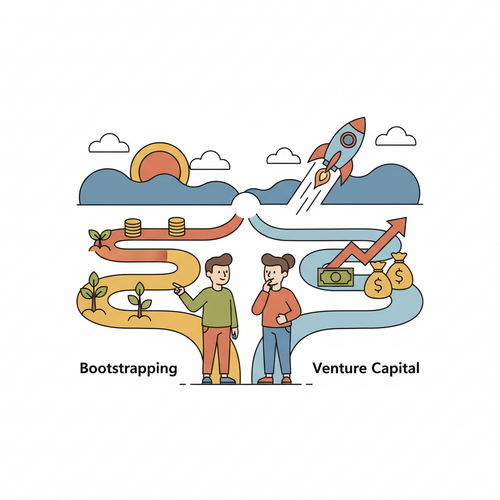
Starting a business is an exciting journey. However, securing the right funding often presents a significant challenge. Entrepreneurs typically face a critical decision early on. They must choose between two primary funding paths: bootstrapping or seeking venture capital. Each option offers distinct advantages and disadvantages. Your choice will profoundly impact your company’s growth trajectory and ownership structure.
Understanding these differences is crucial for any aspiring business owner. This article will thoroughly explore both bootstrapping and venture capital. We will help you determine which funding strategy best aligns with your vision and goals. We will cover definitions, benefits, drawbacks, and key considerations. Ultimately, you will gain clarity to make an informed decision for your venture.
Understanding Bootstrapping
Bootstrapping involves building a company with minimal or no external capital. Entrepreneurs use personal savings, early sales, or small loans. This method emphasizes self-reliance and organic growth. It requires careful financial management from the very beginning.
What is Bootstrapping?
Bootstrapping means funding your business through its own operations. You rely on your own money or the revenue generated by selling products or services. This approach fosters extreme discipline. Founders often make resourceful decisions. They prioritize profitability and cash flow. Many successful companies started this way. They prove that significant capital is not always necessary for initial growth.
Advantages of Bootstrapping
Bootstrapping offers several compelling benefits for entrepreneurs.
- Full Ownership and Control: You maintain 100% equity in your company. All strategic decisions remain solely within your control. This preserves your original vision.
- No Dilution of Equity: You do not give up any portion of your company to investors. This means you keep all future profits.
- Flexibility and Agility: Without external investor demands, you can pivot quickly. You can also experiment with new ideas more freely.
- Focus on Profitability: Bootstrapped companies must generate revenue early. This cultivates a sustainable business model from the start. Profitability becomes a core competency.
- Stronger Business Fundamentals: This path forces lean operations. It encourages efficient resource allocation. As a result, companies often build robust foundational processes.
Disadvantages of Bootstrapping
While appealing, bootstrapping also comes with notable drawbacks.
- Slower Growth Potential: Limited capital can restrict rapid expansion. Scaling operations or hiring quickly becomes challenging.
- Limited Resources and Network: You might lack access to the vast networks and expertise. Venture capitalists often provide these valuable connections.
- Higher Personal Financial Risk: You typically invest your own money. This puts personal assets at risk if the business fails.
- Intense Workload: Founders often wear many hats. They handle sales, marketing, development, and finance themselves. This can lead to burnout.
- Difficulty in Competing: Rivals with significant funding can outspend you. They may hire top talent faster. This can create a competitive disadvantage in fast-moving markets.
Exploring Venture Capital
Venture capital (VC) provides funding to startups and small businesses. These businesses must show high growth potential. VC firms invest in exchange for an equity stake. This funding is often critical for companies aiming for rapid, large-scale expansion.
What is Venture Capital (VC)?
Venture capital is a form of private equity financing. It is provided by venture capital firms or funds. They invest in companies that are typically early-stage. These companies often have innovative technology or business models. VC funding is not a loan. Instead, investors become part-owners of your company. They expect a significant return on their investment when the company exits. This exit usually occurs through an acquisition or an initial public offering (IPO).
Advantages of Venture Capital
Securing venture capital can accelerate a company’s trajectory dramatically.
- Significant Capital Injection: VC provides substantial funds. This enables rapid scaling of operations, product development, and market penetration.
- Access to Expertise and Network: VC firms offer more than just money. They bring invaluable industry knowledge, mentorship, and extensive networks. These connections can open doors to strategic partnerships and talent.
- Credibility and Validation: Receiving VC funding is a strong endorsement. It signals to others that your business has significant potential. This can attract more customers and employees.
- Ability to Scale Quickly: VC allows you to hire more staff. You can also invest in marketing campaigns. This helps you capture market share rapidly, especially in competitive sectors.
- Strategic Guidance: VC partners often sit on your board. They provide strategic oversight. Their experience can guide your company through complex challenges.
Disadvantages of Venture Capital
Despite its allure, venture capital also carries considerable downsides.
- Dilution of Ownership and Control: You give up a portion of your company’s equity. This reduces your ownership stake. It also means you share control with investors.
- Pressure for High Growth and Quick Returns: VC firms expect substantial returns. They often push for aggressive growth targets. This can lead to decisions focused on short-term gains rather than long-term sustainability.
- Loss of Autonomy: Investors will have a say in major decisions. These might include hiring, product direction, or even exit strategies. Your vision may be challenged.
- Rigorous Fundraising Process: Securing VC funding is highly competitive. It requires extensive pitching, due diligence, and negotiation. This process can be time-consuming and distracting.
- Misalignment of Interests: Sometimes, founders and investors might have different goals. Founders might seek long-term impact. Investors typically prioritize financial returns.
Key Factors to Consider When Choosing Your Funding Path
The decision between bootstrapping and venture capital is deeply personal. It also depends on your specific business context. Consider these factors carefully.
Your Business Model and Industry
Evaluate the nature of your business.
- Bootstrapping often suits service-based businesses. It also works for companies with low startup costs. Examples include consultancies, creative agencies, or niche e-commerce. These ventures can generate revenue quickly.
- Venture Capital is more appropriate for high-growth industries. Think technology, biotechnology, or highly scalable software platforms. These often require significant upfront investment in research and development. They also need substantial marketing efforts to achieve market dominance. The potential for a large market share justifies the high risk for VCs.
Growth Ambitions and Timeline
How fast do you want to grow? What is your ultimate vision?
- If you envision steady, controlled growth, bootstrapping might be ideal. You can build a sustainable company at your own pace. You avoid external pressure for hyper-growth.
- If your ambition is to dominate a market rapidly, venture capital is usually essential. VC funding provides the fuel for aggressive expansion. It allows you to outpace competitors. This path is for entrepreneurs who aim for a massive scale within a few years.
Personal Risk Tolerance and Control Desires
Consider your comfort level with risk and your desire for autonomy.
- Are you comfortable taking on significant personal financial risk? Do you value retaining complete control over your company? If so, bootstrapping aligns better with these preferences. You make all the calls.
- Are you willing to dilute your ownership and share control for explosive growth? Do you accept the demands and pressures from investors? Then venture capital might be the right fit. Understand that this means sharing the reins of your company.
Current Financial Health and Resources
Assess your existing financial situation.
- Do you have sufficient personal savings? Can your business generate revenue quickly enough to sustain itself? If yes, bootstrapping is a viable option. It minimizes external dependence.
- Do you lack the personal funds needed for initial development? Does your business require substantial capital to get off the ground? If so, seeking venture capital might be a necessity. This is especially true for capital-intensive ventures. It’s important to know your financial runway. For more insights on financial planning, you can explore resources from the U.S. Small Business Administration.
Real-World Examples: Bootstrapped Success Stories
Many well-known companies achieved significant success without taking venture capital. Their stories prove the power of self-reliance and organic growth.
- Mailchimp: This email marketing giant famously bootstrapped its way to over $700 million in annual revenue before selling a majority stake to Intuit. They focused on customer needs and iterative improvement.
- Basecamp: A project management software company, Basecamp, has been profitable for years. They built their business steadily and focused on a specific target audience. They offer a strong example of sustainable growth without external investment.
- Spanx: Sara Blakely launched Spanx with just $5,000 in personal savings. She built a billion-dollar empire without ever taking outside investment. Her story highlights innovative thinking and persistence.
These examples demonstrate that patience and a strong business model can lead to immense success. They highlight the importance of understanding customer value early on.
Real-World Examples: VC-Backed Success Stories
On the other hand, many global behemoths owe their rapid ascent to venture capital. VC funding allowed them to achieve massive scale quickly.
- Google: Backed by significant venture capital in its early days, Google was able to invest heavily in its search technology. This funding helped it expand globally and become a dominant force.
- Facebook (Meta Platforms): With early investments from firms like Accel Partners and Peter Thiel, Facebook rapidly grew its user base. This capital was crucial for infrastructure development and international expansion.
- Uber: This ride-sharing giant leveraged billions in venture capital. This allowed it to disrupt the transportation industry worldwide. It scaled its operations at an unprecedented pace. You can find more details on how venture capital shapes industries on platforms like Investopedia, which provides comprehensive financial education.
These companies show that for certain business models, especially those with network effects or requiring extensive infrastructure, VC funding can be a game-changer. They transformed their respective industries by utilizing substantial capital.
Conclusion
Choosing between bootstrapping vs venture capital is a foundational decision for any entrepreneur. Both paths offer unique trade-offs regarding control, growth, and risk. There is no universally “right” answer. The optimal choice depends entirely on your individual circumstances. It reflects your personal aspirations, business model, and the market you operate in.
Carefully assess your long-term vision. Consider your tolerance for personal financial risk. Evaluate your desired level of control. If you prioritize autonomy and sustainable, organic growth, bootstrapping may be your ideal route. Conversely, if you aim for rapid, disruptive market dominance and are willing to share equity and control, venture capital could be the catalyst you need. Remember, understanding your goals is the first step. Make an informed decision that empowers your entrepreneurial journey. Finally, always consult with financial advisors to understand the implications of different funding structures for your financial future. You might also want to research current market trends and funding opportunities through reliable sources like the Financial Times’ Venture Capital section.