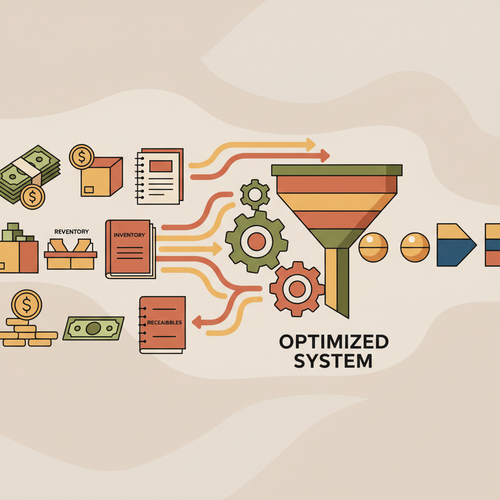
Executive Summary
- Enterprise cash optimization is critical for sustainable financial health and operational agility.
- Advanced methodologies integrate granular data analysis with strategic treasury functions.
- Effective working capital management directly enhances shareholder value and mitigates liquidity risks.
Strategic Imperatives of Cash Flow Velocity
Cash flow velocity fundamentally dictates an enterprise’s financial robustness. Accelerated cash conversion cycles unlock significant strategic advantages. Faster cash generation reduces reliance on external financing. This directly strengthens a firm’s liquidity buffers.
Operational efficiency is a direct beneficiary of optimized cash movement. Businesses can capitalize on emergent market opportunities more swiftly. Effective cash velocity also underpins robust capital allocation decisions. It ensures funds are available for critical investments and debt servicing obligations.
Expert Insight: “In an environment of fluctuating interest rates and economic uncertainty, the agility to manage cash flow velocity can be a primary competitive differentiator, safeguarding against unforeseen market contractions.”
Granular Working Capital Diagnostics: Beyond Basic Metrics
Effective working capital optimization transcends rudimentary balance sheet analysis. A granular diagnostic approach dissects each component of working capital. This involves a deep dive into Accounts Receivable (AR), Accounts Payable (AP), and inventory holdings. Key performance indicators like Days Sales Outstanding (DSO) are meticulously scrutinized.
Days Payable Outstanding (DPO) analysis extends beyond simply delaying payments. It involves strategic vendor relationship management and supply chain finance initiatives. Days Inventory Outstanding (DIO) necessitates sophisticated demand forecasting. These metrics, when holistically managed, reveal actionable insights. They guide precise interventions across the operational landscape.
For a deeper understanding of these core financial metrics, explore Days Sales Outstanding on Investopedia.
Advanced Cash Forecasting and Scenario Modeling
Traditional cash forecasting models often rely heavily on historical data. Advanced methodologies incorporate predictive analytics and machine learning algorithms. This enables more accurate, forward-looking cash flow projections. Probabilistic forecasting quantifies potential variances and associated risks. It moves beyond single-point estimates.
Sophisticated scenario modeling is indispensable for risk mitigation. Enterprises can simulate various market conditions and operational disruptions. This includes “what-if” analyses for economic downturns or supply chain shocks. Integration with enterprise resource planning (ERP) and treasury management systems (TMS) provides real-time data feeds. This enhances forecast accuracy and adaptability. These advanced tools offer a critical edge in treasury management.
Dynamic Liquidity Buffers and Treasury Resilience Frameworks
Dynamic liquidity buffers provide enterprises with enhanced resilience during periods of market disruption and operational uncertainty. Traditional cash reserve strategies often rely on static liquidity thresholds that may not adequately reflect changing business conditions. Modern treasury frameworks utilize real-time financial intelligence, predictive forecasting, and risk-adjusted liquidity models to determine optimal reserve levels continuously. These frameworks evaluate factors such as revenue volatility, debt obligations, supplier dependencies, and macroeconomic developments.
Dynamic reserve allocation enables organizations to maintain operational continuity while minimizing the opportunity cost of idle capital. Treasury teams can deploy excess liquidity into short-duration investments without compromising emergency funding requirements. Furthermore, adaptive liquidity buffers improve financial flexibility during periods of elevated interest rates, supply chain disruptions, or unexpected market contractions. By aligning liquidity reserves with evolving risk profiles, enterprises strengthen capital preservation capabilities and improve long-term financial stability.
Optimizing the Procure-to-Pay (P2P) Cycle for Cash Leverage
The Procure-to-Pay (P2P) cycle presents substantial opportunities for cash optimization. Strategic management of accounts payable is paramount. Dynamic discounting programs allow for early payment discounts when advantageous. Conversely, strategically extending payment terms can improve DPO. This requires strong vendor relationships and clear communication.
Automating invoice processing reduces administrative overhead. It minimizes errors and accelerates reconciliation. Supply chain finance platforms facilitate a healthier ecosystem for both buyers and suppliers. These tools provide visibility and control over cash outflows. They convert liabilities into strategic cash leverage points. Each P2P cycle improvement directly impacts the enterprise’s liquidity position.
Accelerating the Order-to-Cash (O2C) Cycle: Revenue Velocity
Enhancing the Order-to-Cash (O2C) cycle directly accelerates revenue realization. This minimizes the time between sale and cash receipt. Robust credit policies are fundamental. They mitigate the risk of bad debt. Proactive customer communication and streamlined invoicing processes reduce payment delays.
Automated collections and dispute resolution mechanisms improve efficiency. Lockbox services can accelerate physical check processing. Exploring early payment incentives for customers can reduce DSO. Strategic factoring or supply chain finance solutions convert receivables into immediate cash. These tactics collectively boost an enterprise’s cash conversion cycle significantly. They provide critical working capital.
Receivables Intelligence and Customer Payment Optimization
Receivables intelligence has emerged as a critical discipline within advanced enterprise cash optimization strategies. Traditional accounts receivable management frequently relies on reactive collection processes that address payment delays only after they occur. Modern analytical platforms leverage behavioral payment data, customer credit profiles, and historical transaction patterns to identify collection risks proactively. Predictive scoring models enable finance teams to segment customers based on expected payment behavior and tailor collection strategies accordingly. Automated reminder systems, dynamic payment terms, and intelligent dispute resolution workflows further accelerate cash realization.
Enhanced receivables visibility also supports more accurate liquidity forecasting by reducing uncertainty surrounding future cash inflows. Organizations that integrate receivables intelligence into their treasury operations often experience lower delinquency rates, improved Days Sales Outstanding performance, and stronger working capital efficiency. These capabilities transform accounts receivable from a passive accounting function into a strategic driver of enterprise liquidity.
Inventory Optimization: Balancing Capital and Service Levels
Inventory represents a substantial capital investment. Effective optimization balances carrying costs with customer service levels. Beyond simply reducing stock, it involves sophisticated demand forecasting. This minimizes both stockouts and excess inventory. Implementing ABC analysis prioritizes inventory management efforts. High-value items receive closer scrutiny.
Vendor-Managed Inventory (VMI) programs can shift inventory management responsibility to suppliers. Just-in-Time (JIT) methodologies reduce inventory holding periods. However, a hybrid approach might be necessary given supply chain volatility. Regular inventory turn ratio analysis identifies inefficiencies. It highlights opportunities for capital liberation. Optimal inventory strategies directly enhance working capital efficiency. They reduce obsolescence risk.
Leveraging Technology: Treasury Management Systems (TMS) and AI
Modern enterprise cash optimization is inherently technology-driven. Treasury Management Systems (TMS) provide centralized visibility and control over global cash. They automate routine treasury operations. Features include real-time cash positioning, automated payments, and comprehensive bank connectivity. This significantly reduces manual effort and operational risk.
Artificial Intelligence (AI) and Machine Learning (ML) are transforming treasury functions. AI-powered analytics predict cash flow fluctuations with greater precision. They identify anomalies and potential fraud. Robotic Process Automation (RPA) automates repetitive tasks like data entry and reconciliation. API integration facilitates seamless data exchange between TMS, ERP, and banking platforms. These technological advancements create intelligent, adaptive cash management ecosystems.
Global Cash Pooling and Intercompany Netting Strategies
Multinational corporations derive immense benefit from global cash pooling. This strategy aggregates balances from multiple subsidiary accounts. It centralizes cash, reducing external borrowing needs and interest expenses. Notional pooling allows for interest optimization without physical cash transfers. Physical pooling involves actual transfer of funds. Both enhance liquidity and facilitate efficient intercompany lending.
Intercompany netting streamlines cross-border payments between subsidiaries. It reduces the number of individual transactions. This minimizes foreign exchange exposure and bank fees. Legal and regulatory frameworks in each jurisdiction must be carefully navigated. Implementing these sophisticated strategies requires robust treasury infrastructure. They significantly enhance global working capital efficiency. These practices also strengthen financial control across diverse operational geographies.
For a comprehensive overview of global financial liquidity, refer to resources on Cash Management on Investopedia.
Conclusion
Enterprise cash optimization is not merely a financial exercise. It is a strategic imperative for sustained growth and resilience. Advanced methodologies provide a framework for superior working capital management. These approaches enhance liquidity and mitigate critical risks. They empower organizations with greater financial agility.
Implementing sophisticated tools and analytical insights is paramount. This drives efficiency across the entire financial ecosystem. The integration of technology and strategic foresight defines leading treasury functions. Are your current cash optimization strategies sufficiently agile to navigate tomorrow’s complex economic landscape?