Executive Summary
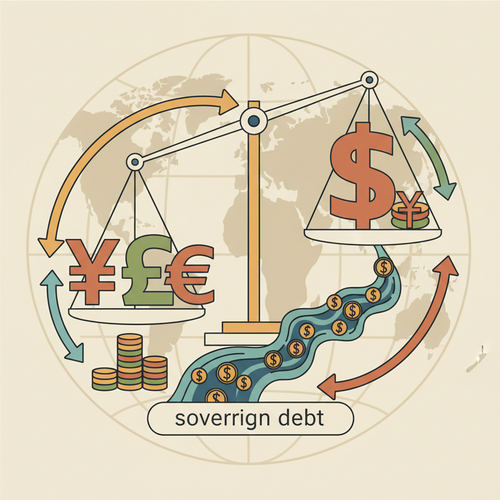
- Sovereign debt volatility presents complex challenges and unique opportunities for sophisticated investors.
- Cross-border interest rate arbitrage leverages these market dislocations for potential risk-adjusted returns.
- Mastering these strategies requires profound macroeconomic insight and rigorous risk management protocols.
Deconstructing Sovereign Debt Volatility Dynamics
Sovereign debt represents a government’s total outstanding financial liabilities. Its volatility stems from various macroeconomic and geopolitical factors. These factors often trigger significant shifts in bond yields.
Market participants constantly reassess a nation’s ability to service its debt obligations. Perceived changes in creditworthiness directly impact bond prices. This creates periods of pronounced market instability.
Key drivers include shifts in monetary policy. Central bank actions, such as interest rate adjustments, directly influence borrowing costs. Fiscal policy decisions, like budget deficits or surpluses, also play a critical role.
Geopolitical events further exacerbate volatility. Regional conflicts, trade disputes, or political instability within a nation introduce unforeseen risks. These events can trigger capital flight and currency depreciation. Understanding these complex interdependencies is paramount for accurate market forecasting.
The Mechanics of Cross-Border Interest Rate Arbitrage
Cross-border interest rate arbitrage seeks to profit from interest rate differentials across different countries. This strategy inherently involves foreign exchange markets. It relies on the principle of interest rate parity.
Arbitrageurs exploit temporary discrepancies in these rates. They typically borrow in a low-interest-rate currency. Concurrently, they invest in a high-interest-rate currency. Hedging currency risk is crucial for most strategies.
Covered Interest Rate Parity (CIRP) forms the theoretical bedrock. CIRP suggests that the interest rate differential between two countries equals the differential between the spot and forward exchange rates. Any deviation offers an arbitrage opportunity.
Uncovered Interest Rate Parity (UIRP) does not involve hedging. It implies that the expected change in the exchange rate offsets the interest rate differential. UIRP strategies carry significantly higher currency risk. Practical implementation often involves complex financial instruments.
Expert Insight: “Effective arbitrage requires swift execution and robust analytical models. Market inefficiencies are often fleeting.”
Interplay: Volatility as an Arbitrage Catalyst
Sovereign debt volatility often creates market dislocations. These anomalies can be precisely what arbitrageurs seek. Periods of heightened uncertainty can lead to mispricings across asset classes.
For instance, a sudden downgrade in a nation’s credit rating increases its bond yields. This can widen interest rate differentials with more stable economies. Such events present a window for strategic arbitrage.
Currency fluctuations further amplify these opportunities. A depreciating currency, coupled with rising domestic rates, offers complex arbitrage pathways. Investors must meticulously analyze both fixed-income and FX markets.
Arbitrage strategies become particularly compelling during ‘flight to quality’ episodes. Capital flows disproportionately into perceived safe-haven assets. This creates artificial demand and lower yields in specific sovereign bonds. Concurrently, other markets experience sell-offs and higher yields.
Risk Mitigation in Sovereign Debt Arbitrage Strategies
Arbitrage is not risk-free, especially in volatile sovereign debt markets. Managing currency risk is paramount. Employing forward contracts or currency options can effectively hedge against adverse FX movements.
Liquidity risk also demands attention. Some sovereign bond markets may experience reduced trading volumes. This makes exiting positions challenging without significant price impact. Diversification across multiple sovereign issuers can mitigate this.
Political risk remains a significant concern. Unexpected policy changes, capital controls, or debt restructuring can severely impact returns. Thorough due diligence on a nation’s political landscape is indispensable.
Interest rate risk also persists, even with hedged positions. Unexpected shifts in global or domestic interest rate trajectories can erode profit margins. Constant monitoring and dynamic rebalancing of portfolios are crucial. For further reading on managing financial risk, consider this Investopedia resource on Sovereign Debt.
Quantitative Approaches to Identifying Arbitrage Opportunities
Sophisticated investors utilize advanced quantitative models. These models detect fleeting arbitrage opportunities. They process vast amounts of real-time market data.
Yield curve analysis is a fundamental tool. Inversions or unusually steep sections of the yield curve can signal mispricings. Comparing yield curves across different nations offers critical insights.
Econometric models, such as cointegration analysis, identify stable long-term relationships between asset prices. Deviations from these relationships suggest potential arbitrage. Machine learning algorithms are increasingly deployed to predict these anomalies.
Derivatives pricing models also play a key role. Discrepancies between theoretical and observed prices for interest rate swaps or bond futures can reveal arbitrage avenues. Calibration of these models with real market data is essential.
- Real-time data aggregation and processing
- Algorithmic trading platforms for execution
- Stress testing models against extreme market conditions
- Continuous refinement of predictive analytics
Regulatory Frameworks and Their Impact on Arbitrage
Regulatory environments significantly influence cross-border arbitrage. Central bank policies are particularly impactful. Interventions in currency markets can distort exchange rates and interest rate parity conditions.
Capital controls imposed by governments restrict the free flow of funds. These measures directly impede arbitrage strategies. They limit the ability to move capital across borders efficiently.
International agreements and financial stability regulations also shape the landscape. Basle III accords, for example, influence bank capital requirements. This affects their participation in certain arbitrage activities.
Taxation policies on cross-border income or capital gains vary widely. These differences can drastically alter the profitability of arbitrage trades. Compliance with diverse international tax regimes is a complex undertaking. For a deeper dive into the theoretical underpinnings, explore this resource on Interest Rate Parity.
Case Studies in Global Sovereign Debt Markets
Examining historical events provides invaluable lessons. The Eurozone sovereign debt crisis (2010-2012) offered profound arbitrage opportunities. Yield spreads between peripheral and core European bonds widened dramatically.
Investors exploited these divergences. They navigated complex political negotiations and ECB interventions. These events highlighted the interplay of fiscal health, monetary policy, and market sentiment.
Emerging market sovereign debt frequently experiences higher volatility. Currency devaluations and interest rate hikes create conditions ripe for specific arbitrage strategies. However, these markets also carry elevated risk premiums.
Post-pandemic recovery efforts have introduced new dynamics. Massive fiscal stimulus and accommodative monetary policies have influenced yield curves globally. Discrepancies arising from differing national recovery trajectories present ongoing arbitrage potential.
Market Warning: “While lucrative, sovereign debt arbitrage demands constant vigilance. Unforeseen ‘black swan’ events can rapidly reverse profitability.”
Conclusion
Sovereign debt volatility offers a fertile ground for sophisticated cross-border interest rate arbitrage. These strategies require deep understanding of macroeconomic forces. Rigorous risk management frameworks are non-negotiable.
Investors must navigate complex regulatory landscapes. They also need to leverage advanced quantitative analytics. Identifying fleeting market inefficiencies is key.
The global financial ecosystem continually evolves. New challenges and opportunities will emerge. Are your current investment strategies robust enough to capitalize on the next wave of sovereign market dislocations?