Introduction
Interest rates are one of the most powerful financial tools in the modern world. They influence how individuals save, borrow, invest, and even how entire nations manage their economic policies. Whether you’re applying for a credit card, taking out a mortgage, investing in bonds, or evaluating global markets, interest rates play a crucial role in shaping financial decisions. Despite their significance, many people only understand interest rates at a surface level — as the percentage charged by banks when borrowing money. In reality, they are a complex, multi-layered mechanism that reflects monetary policy, risk, inflation, and investor sentiment.
This article takes a deeper dive into interest rates, exploring their types, the factors that determine them, their impact on personal finance and the global economy, and strategies individuals can adopt to manage them effectively.
What Are Interest Rates?
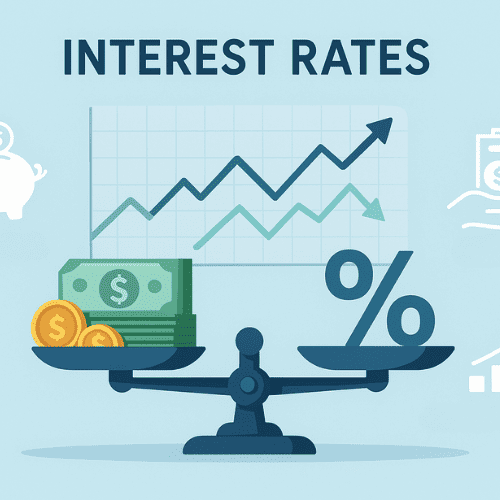
At their core, interest rates represent the cost of borrowing money or the reward for lending money. When you borrow from a bank, the interest rate determines how much you will pay in addition to the principal. Conversely, when you save or invest, the interest rate dictates how much you earn.
Economists often describe interest rates as the “price of money.” Just as goods and services have prices influenced by supply and demand, the availability of credit, government policies, and investor confidence all shape interest rates.
Types of Interest Rates
Understanding interest rates requires examining the different types that affect consumers, businesses, and investors:
-
Nominal Interest Rate
The stated rate without considering inflation. For example, if a loan has a 6% nominal interest rate, that’s what you see on paper. -
Real Interest Rate
Adjusted for inflation, it reflects the actual purchasing power gained or lost. If inflation is 3% and the nominal rate is 6%, the real interest rate is 3%. -
Fixed Interest Rate
Remains unchanged throughout the loan or investment period, offering predictability. -
Variable (or Floating) Interest Rate
Changes based on benchmark rates, such as the Federal Reserve rate or LIBOR, often making it riskier but potentially rewarding in a low-rate environment. -
Simple vs. Compound Interest
-
Simple interest applies only to the principal amount.
-
Compound interest applies to both the principal and accumulated interest, significantly increasing returns (or costs) over time.
-
What Determines Interest Rates?
Several key factors influence how high or low interest rates are set globally and locally:
-
Central Bank Policy
Central banks, such as the U.S. Federal Reserve or the European Central Bank, adjust interest rates to control inflation and stabilize the economy. -
Inflation
If inflation rises, central banks often increase interest rates to reduce spending and borrowing. -
Economic Growth
A booming economy typically increases demand for loans, pushing rates higher, while slowdowns often lower rates to stimulate borrowing. -
Supply and Demand of Credit
More demand for loans usually results in higher interest rates. -
Risk Factors
Lenders charge higher rates for riskier borrowers. This is why individuals with poor credit scores face higher credit card or loan rates. -
Global Events
Geopolitical tensions, pandemics, or financial crises can cause sudden shifts in interest rates as governments react to uncertainty.
The Impact of Interest Rates on Personal Finance
Interest rates directly shape everyday financial decisions:
-
Mortgages: A small increase in interest rates can significantly affect monthly payments. For example, a 1% rise on a 30-year mortgage can add tens of thousands of dollars in interest over the loan’s lifetime.
-
Credit Cards: Credit cards usually carry some of the highest interest rates, often above 20%, making debt repayment expensive if balances aren’t managed.
-
Savings Accounts: When rates are high, savers benefit from greater returns on deposits. When they are low, banks often offer negligible interest, pushing individuals to seek alternatives like investments.
-
Student Loans: Many students face decades of repayment challenges depending on whether their loans have fixed or variable rates.
-
Investments: Higher interest rates generally decrease stock market valuations but increase bond yields, shifting investor behavior.
Interest Rates and the Global Economy
On a macroeconomic scale, interest rates are vital levers for stability:
-
Inflation Control: High rates slow down consumer spending, reducing inflation.
-
Employment: Low rates stimulate borrowing and investment, potentially increasing job creation.
-
Currency Strength: A country with higher rates tends to attract foreign investors, strengthening its currency.
-
Government Debt: Higher rates increase the cost of servicing national debt, which can restrict government budgets.
For example, during the 2008 financial crisis, central banks slashed interest rates near zero to encourage lending and stabilize financial markets. Conversely, in the aftermath of the COVID-19 pandemic, inflationary pressures forced central banks to raise rates aggressively to prevent overheating economies.
Strategies to Manage Interest Rates in Personal Finance
-
Improve Your Credit Score
A higher credit score gives you access to lower interest rates. This can save thousands over the life of a loan. -
Refinance Loans
When rates drop, refinancing mortgages or student loans can reduce long-term costs. -
Pay Off High-Interest Debt First
Focus on credit card balances and personal loans before tackling lower-interest debt. -
Leverage Compound Interest in Investing
Start early with retirement accounts or savings plans to benefit from compounding. -
Diversify Investments
Bonds, savings accounts, and dividend-paying stocks can balance risks when interest rates fluctuate.
The Future of Interest Rates
As global economies evolve, interest rates will continue to shift. Key future drivers include:
-
Digital Banking & Fintech: New lending platforms may offer more competitive rates.
-
Global Debt Levels: Rising debt across nations may limit central banks’ ability to hike rates aggressively.
-
Climate Change Investments: Financing sustainable infrastructure may affect borrowing costs worldwide.
-
Artificial Intelligence & Data: Advanced algorithms could reshape how banks assess risk and set personalized rates.
In the coming years, individuals and businesses will need to stay informed and agile, making strategic financial decisions based on the changing interest rate environment.
Conclusion
Interest rates are far more than a number on a loan agreement. They shape economies, influence investments, and directly affect how individuals manage their personal finances. By understanding the different types of interest rates, the factors that influence them, and their impact on both micro and macro levels, individuals can make smarter decisions when borrowing, saving, or investing.
In a world of uncertainty, where inflation, geopolitical risks, and technological changes constantly reshape the financial landscape, knowledge of interest rates is not just an academic exercise — it is a practical necessity for financial stability and growth.