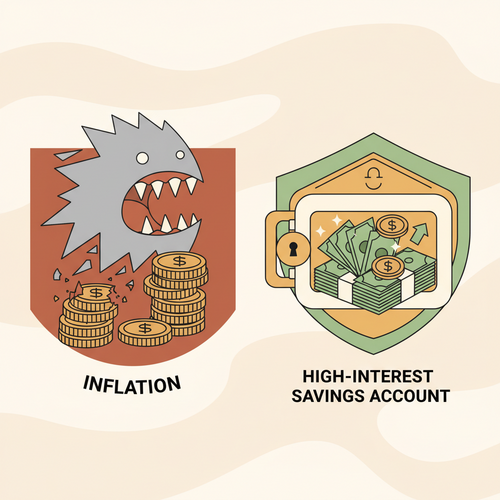
Understanding inflation and high-interest savings accounts is crucial for any beginner investor. Indeed, the relationship between these two financial concepts directly impacts your money’s value over time. Therefore, grasping their correlation helps you make smarter decisions. Consequently, your hard-earned cash can work more effectively for you. This article will explore inflation and high-interest savings accounts, explaining their interaction specifically for new investors.
Understanding Inflation: The Silent Money Eater
Inflation, fundamentally, refers to the rate at which the general level of prices for goods and services is rising. Furthermore, as prices increase, the purchasing power of your currency inevitably declines. For instance, a dollar today might buy significantly less than it could a year ago. Therefore, your money’s intrinsic value slowly erodes over time. This continuous rise in prices forms a natural part of most healthy economies. Indeed, it is a key economic indicator policymakers monitor closely.
What is Inflation?
Specifically, inflation measures the average percentage change of a pre-determined basket of consumer goods and services. Government agencies, like the Bureau of Labor Statistics in the U.S., track these changes meticulously. They often use consumer price indexes (CPI) for this precise purpose. Consequently, economists can observe and report on broad trends in pricing across various sectors. A 2% annual inflation rate means that, on average, the prices of goods and services are 2% higher than they were twelve months prior. This seemingly small percentage can have a significant cumulative effect. Thus, it’s vital to acknowledge its presence.
Indeed, various interconnected factors can cause inflation. These include increased aggregate demand for goods and services, often spurred by economic growth or fiscal stimulus. Also, rising production costs, such as energy or raw materials, can directly contribute to higher prices for consumers. Furthermore, government monetary policies or unpredictable global events sometimes exacerbate inflationary pressures. Understanding these underlying causes helps us anticipate potential economic shifts. Conversely, a sustained decrease in prices, known as deflation, also presents its own unique economic challenges for businesses and consumers. Thus, inflation represents a complex economic phenomenon with wide-reaching implications for everyone.
How Inflation Affects Your Purchasing Power
The most immediate and tangible effect of inflation is on your purchasing power. Simply put, your existing money buys fewer goods and services. Consider a monthly grocery bill that consistently grows more expensive each month, even for the same items. Therefore, your fixed income stretches less far than it used to. Over time, this erosion of purchasing power can be quite substantial. For instance, if you keep a significant amount of cash strictly under your mattress, its actual value decreases annually due to inflation.
Specifically, this phenomenon impacts savers significantly and directly. Money saved today might not afford the same quality of life or the same quantity of goods tomorrow. Therefore, investors actively seek ways to counter this relentless erosion of value. People often feel the pinch of inflation in everyday expenses. Gas prices, food costs, housing rent, and utility bills are common and relatable examples. Thus, protecting your savings from inflation’s bite becomes a key financial goal for long-term security. It strongly emphasizes the crucial need for strategic and proactive financial planning.
High-Interest Savings Accounts: Your Financial Ally
Fortunately, certain prudent financial tools exist to help individuals mitigate inflation’s pervasive impact. High-interest savings accounts (HISAs) stand out as one such effective tool. They consistently offer a demonstrably better return on your deposited funds compared to traditional accounts. Consequently, your money gains a crucial opportunity to grow rather than merely sit idle. These accounts often provide a safe and accessible haven for your cash. Moreover, they still allow for relatively easy access to your funds when needed. Thus, they strike a balance between liquidity and growth.
Defining High-Interest Savings Accounts (HISAs)
A high-interest savings account is a specialized type of savings vehicle. It typically offers significantly higher interest rates than standard, conventional savings accounts. Furthermore, these attractive accounts are most often found at online banks, challenger banks, or local credit unions. Their streamlined operational models and lower overhead costs enable them to pass on more substantial savings to their customers. Therefore, they can consistently provide more attractive and competitive interest rates. This crucial distinction is paramount for maximizing your savings growth and retaining purchasing power.
Indeed, HISAs are distinctly separate from checking accounts, which are designed for frequent transactions. They are purpose-built for saving money, not for daily transactional activities. While you can access your funds with relative ease, they might sometimes have specific transaction limits or transfer restrictions. Consequently, these features subtly encourage disciplined saving rather than constant, impulsive spending. For instance, some financial institutions may limit out-of-bank withdrawals or transfers to six per statement cycle. They are also universally federally insured, often by the FDIC or NCUA, providing invaluable peace of mind for depositors. Thus, your principal investment is generally safe up to the defined legal limits. For further details, consult resources like the Federal Reserve.
How HISAs Work
When you thoughtfully deposit money into a HISA, the bank diligently pays you interest on that specific balance. This earned interest is typically compounded daily or monthly, significantly accelerating your returns. Consequently, your earnings grow not only on your initial principal deposit but also on the previous interest earnings. This mechanism beautifully demonstrates the formidable power of compound interest at work. Therefore, your money grows exponentially over time, especially over longer saving horizons. This makes HISAs an intelligent choice for emergency funds or short-term goals.
Specifically, interest rates on HISAs are generally variable, meaning they are subject to change. They fluctuate primarily based on prevailing economic conditions and central bank policies. For instance, if the central bank, like the Federal Reserve, raises its benchmark interest rate to curb inflation, HISA rates often follow suit, sometimes with a slight delay. Conversely, these rates may decline during periods of economic downturns or when central banks aim to stimulate economic activity. It is therefore critically important to regularly monitor these potential changes. Thus, proactively checking your account’s Annual Percentage Yield (APY) is a remarkably smart and beneficial practice. The APY accurately reflects the total interest earned over an entire year, taking compounding into account.
The Interplay: Inflation and HISAs
The core correlation between inflation and high-interest savings accounts lies in how HISA interest rates respond to inflationary pressures. Ideally, your HISA rate should, at the very least, keep pace with or ideally surpass the current inflation rate. When it successfully does, your money effectively retains its purchasing power, or even slightly increases it. Conversely, if the prevailing inflation rate significantly outpaces your HISA’s nominal interest rate, your “real return” on savings becomes negative. This means you are effectively losing money in terms of purchasing power, despite earning some interest. Therefore, understanding and actively monitoring this delicate balance is paramount for all beginner investors aiming to preserve their wealth.
When Inflation Rises: The HISA Response
Central banks worldwide frequently employ interest rate hikes as a primary monetary policy tool to combat persistently high inflation. This makes borrowing more expensive. Consequently, it tends to cool down overall economic activity and reduce demand, thus aiming to stabilize prices. High-interest savings accounts typically benefit directly from this type of monetary tightening. Their rates often rise in tandem with central bank benchmark rate hikes, albeit sometimes with a slight lag. For instance, during recent periods of elevated inflation, many investors observed HISA rates climbing significantly, offering a buffer against rising costs.
Indeed, this scenario provides a timely opportunity for astute savers. Your money can subsequently earn a higher nominal return, helping to directly offset the rising cost of living. Therefore, it is a critical protective mechanism for your finances. Conversely, if inflation is low and economic growth is sluggish, HISA rates might also be comparatively lower as central banks try to stimulate spending. It’s a dynamic and responsive relationship, accurately reflecting broader economic health and monetary policy direction. Thus, an aware investor diligently monitors both inflation reports and competitive HISA offerings. This proactive approach helps to protect and even enhance your wealth. You can find reliable and up-to-date economic data on highly respected financial news sites like Reuters or Bloomberg.
The Real Return on Your Savings
The “real return” on your savings is unequivocally crucial for accurate financial assessment. It precisely measures how much your money has genuinely grown after carefully accounting for the eroding effects of inflation. To accurately calculate it, you simply subtract the current inflation rate from your nominal HISA interest rate. For example, if your HISA offers a 3% nominal interest rate and the annual inflation rate stands at 2%, your real return is a positive 1%. Therefore, your purchasing power has indeed slightly increased over the year.
Conversely, if annual inflation is running at 4% and your HISA offers only 3% interest, your real return is a negative 1%. This means that, despite earning nominal interest, your money is actually losing real value or purchasing power. Specifically, your funds will buy less than they did before the period began. Therefore, always actively strive for a positive real return on all your savings. This critically ensures that your savings are growing in actual purchasing power, not just numerically. It’s a fundamental concept for effective wealth preservation and long-term financial stability. Understanding this metric protects your long-term financial health and helps you make truly informed decisions. Regularly check official government statistics for inflation rates.
Strategies for Beginner Investors
Navigating the intricate relationship between inflation and HISAs effectively requires adopting a few key strategic approaches. Beginner investors can readily adopt these simple yet powerful steps. Consequently, they can significantly optimize their savings and proactively protect their financial future. These strategies primarily focus on continuous awareness and decisive action. Indeed, being consistently proactive and engaged with your personal finances pays considerable dividends over time.
Choosing the Right HISA
It is important to remember that not all HISAs are created equal in their offerings. Different financial institutions offer widely varying interest rates and terms. Therefore, diligently shopping around and comparing options is absolutely essential for maximizing your returns. Compare the Annual Percentage Yields (APYs) from multiple reputable institutions. Specifically, consider online-only banks or fintech platforms, which often provide demonstrably higher rates due to lower operational overheads. Furthermore, always look for accounts that feature no monthly maintenance fees, as these charges can quickly eat into your hard-earned interest earnings.
Specifically, also carefully check for any minimum balance requirements. Some HISAs necessitate maintaining a certain balance to earn the highest advertised rates. Conversely, other accounts are much more flexible, offering competitive rates on any balance amount. Always read the fine print and terms and conditions meticulously before committing. Thus, you can confidently find an account that optimally suits your specific financial needs and goals. The overarching goal is to consistently maximize your interest earnings while minimizing fees. You can explore various HISA options by visiting the websites of reputable financial institutions or by consulting general financial guidance from sources like the The U.S. Department of the Treasury.
Regularly Reviewing Interest Rates
HISA interest rates are inherently dynamic and not static. They constantly fluctuate in response to broader economic conditions and central bank policy adjustments. Therefore, it is critically important to review your specific account’s rate periodically and proactively. Compare it to the current market offerings from competitors. If your existing bank’s rate falls significantly behind the market, seriously consider switching to a more competitive provider. Switching banks or transferring funds between accounts can be a surprisingly straightforward process with modern digital banking tools.
Indeed, staying consistently informed about market rates helps you maintain a competitive rate on your savings. Consequently, your money continues to work as hard as possible for you, instead of lagging behind. For instance, consider setting a recurring reminder every three to six months to check and compare HISA rates. This remarkably simple habit can make a substantial difference in your long-term earnings. Thus, always be vigilant and proactive about your savings’ overall performance. It ensures you are not leaving money on the table.
Diversifying Your Savings
While HISAs are undeniably excellent for safely holding emergency funds and achieving short-term financial goals, they might not be the single, ultimate answer for all your investment needs. Diversification stands as a cornerstone principle in prudent investing. Therefore, beginner investors should strategically consider other complementary investment vehicles as part of a broader financial plan. These could intelligently include Certificates of Deposit (CDs), which offer fixed rates, government bonds for stability, or even carefully selected exchange-traded funds (ETFs) or stocks for growth potential. Each of these options inherently carries different risk and return profiles.
Furthermore, CDs offer predictable, fixed rates for a set period, which can be particularly beneficial during times of stable or declining interest rates. Conversely, equity investments like stocks offer higher potential returns but inherently come with greater market volatility and risk. A balanced and well-thought-out approach is almost always best for long-term financial success. Consider consulting a qualified financial advisor for personalized advice tailored to your unique circumstances and risk tolerance. Thus, a thoughtfully diversified portfolio helps protect against various economic scenarios and helps you achieve multiple financial objectives. Resources like the World Bank often offer valuable insights into global economic trends that can influence various investment decisions, providing a broader context for your choices.
Conclusion
The correlation between inflation and high-interest savings accounts is a fundamental and indispensable concept for all beginner investors. Inflation inherently erodes purchasing power, while strategically utilized HISAs offer a vital defense against this insidious erosion. By understanding precisely how these two powerful economic forces interact, you can make profoundly informed and proactive financial decisions. Consequently, you empower your hard-earned money to grow meaningfully and effectively. Always diligently strive for a positive real return on all your savings. Furthermore, regularly review your HISA rates for competitiveness and critically consider intelligently diversifying your financial holdings beyond just savings accounts. Thus, armed with this essential knowledge, you can confidently navigate the dynamic economic landscape and diligently build a more secure and prosperous financial future. Protecting your wealth through smart, informed savings strategies is an incredibly rewarding and essential endeavor for long-term financial independence.