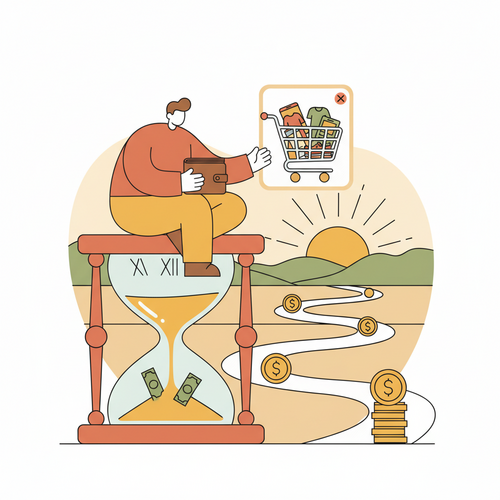
Do you ever find yourself buying things you don’t really need?
Impulse buying is a common trap, often leaving us with buyer’s remorse and a lighter wallet.
Quick Summary
- ⏳ The 72-Hour Rule is a simple waiting period before non-essential purchases.
- 🧠 It helps you overcome emotional spending and make rational decisions.
- 💰 Applying this rule consistently can significantly improve your financial health.
From my own journey, I’ve seen how easily those small, unplanned purchases add up.
A new gadget here, a trendy item there – suddenly, your budget is stretched thin.
What is the 72-Hour Rule?
The 72-Hour Rule is incredibly straightforward: when you want to buy something non-essential, you simply wait 72 hours before making the purchase.
This isn’t about denying yourself entirely, but rather creating a deliberate pause.
During this waiting period, you’re not just twiddling your thumbs.
You actively reflect on whether the item is truly necessary, if it aligns with your financial goals, and if you can genuinely afford it without stress.
Many people, myself included, have found this small trick to be incredibly powerful.
It shifts your mindset from instant gratification to thoughtful consideration.
Why Does It Work So Well?
Our brains are wired for immediate rewards, especially when emotions are high.
Impulse purchases often stem from feelings like boredom, stress, or the excitement of a “deal.”
The 72-hour delay allows those initial emotions to subside.
It gives your rational brain a chance to catch up and evaluate the decision logically.
Think of it as a cooling-off period for your wallet.
You gain perspective and often realize you didn’t need the item after all, saving you money and regret.
Pro Tip: Use the 72-hour waiting period to research alternative products or cheaper options. You might find a better deal or realize the initial item wasn’t the best fit for your real needs.
Benefits of Embracing the 72-Hour Rule
Embracing this rule brings a cascade of positive financial and psychological benefits.
It’s more than just saving money; it’s about gaining control and peace of mind.
- 💰 Saves You Money: This is the most obvious benefit. You’ll simply buy fewer things you don’t truly need, directly boosting your savings.
- 🤔 Fosters Mindful Spending: You become more aware of where your money is going and why, leading to more intentional financial choices.
- 📉 Reduces Buyer’s Remorse: Thoughtful purchases, made after reflection, lead to significantly less regret and more lasting satisfaction.
- 📈 Improves Financial Discipline: It builds a consistent habit of self-control, strengthening your ability to make wise financial decisions over time.
- 🎯 Helps Achieve Financial Goals: More money saved from avoided impulse buys means quicker progress towards your essential savings, investments, or debt reduction targets.
- 🧘 Lowers Financial Stress: Knowing you’re in control of your spending reduces anxiety related to money.
How to Implement the 72-Hour Rule
Implementing this rule is simple, but requires consistency and a commitment to your financial well-being.
Here’s a clear, step-by-step guide to integrate it into your daily life:
-
Step 1: Identify the Impulse
- 🚨 Recognize the urge to buy something non-essential the very moment it strikes.
- This could be an enticing online ad, a captivating store display, or even a friend’s enthusiastic recommendation for a new gadget.
-
Step 2: Start the Clock
- ⏰ Immediately tell yourself, “I’ll wait 72 hours before considering this.” Crucially, don’t add it to your online cart or commit to anything yet.
- Consider setting a reminder on your phone or writing a note to revisit the item in three days.
-
Step 3: Reflect During the Wait
- 🧐 Actively engage in critical thinking during these three days. Ask yourself questions like: Do I truly need this? Can I comfortably afford it without impacting my budget? Will it bring lasting value or just fleeting excitement?
- Think about your existing possessions; do you already own something similar that serves the same purpose?
-
Step 4: Re-evaluate and Decide
- ✅ After 72 hours have passed, revisit the item. More often than not, you’ll find that the initial, intense urge will have completely disappeared.
- If you still genuinely want it, and it aligns with your needs and financial criteria, then consider making the purchase without guilt.
This systematic process encourages a healthier, more intentional relationship with your money.
You take control back from fleeting desires and the constant barrage of external marketing pressures.
Case Study: Impulse vs. Intentional Spending
To truly appreciate the power of the 72-hour rule, let’s look at how it dramatically changes decision-making.
Consider these two scenarios side-by-side to see the practical difference:
Overall SatisfactionFleeting, sometimes followed by guiltGenuine and lasting contentment
| Feature | Impulse Purchase | 72-Hour Rule Purchase |
|---|---|---|
| Decision Time | Minutes or Seconds | At least 72 hours |
| Emotional State | High excitement/desire, urgency | Calm and rational consideration |
| Research Level | Minimal to none, often biased | Thorough, comparative analysis |
| Financial Impact | Often unplanned, budget strain | Planned, aligns with budget & goals |
| Likelihood of Regret | High, leading to guilt or returns | Low, leading to satisfaction |
| Long-term Value | Often low or short-lived utility | Higher, more deliberate choice |
As you can clearly see, the contrast between these two approaches is stark.
One path leads to potential regret and financial instability, the other to empowerment and peace of mind.
Warning: Be rigorously honest with yourself. Don’t “cheat” the rule by rationalizing an impulse as “essential” when it’s clearly not. This undermines the entire strategy’s effectiveness.
Expanding the Rule: Beyond 72 Hours
While 72 hours is an excellent starting point, you can and should adjust the waiting period based on the cost and significance of the item.
For very large purchases, such as a new car, a major home appliance, or a significant investment, a week or even a month might be a more appropriate and prudent waiting period.
The core principle remains the same, regardless of the specific duration.
It’s fundamentally about creating enough emotional and temporal distance from the initial urge to allow for a thorough, unbiased review of the potential purchase.
Consider linking your waiting period directly to your broader financial savings goals.
For example, if you’re diligently saving for a down payment on a house, every avoided impulse buy is a significant win that accelerates your progress.
Learn more about personal finance strategies and global markets at Bloomberg.
The Psychological Edge of Waiting
The 72-hour rule isn’t solely about financial gains; it’s also a remarkably powerful psychological tool for self-improvement.
It actively helps you develop crucial traits like patience, self-control, and delayed gratification, which are valuable in all aspects of life.
By consistently practicing this rule, you are effectively retraining your brain’s reward system.
You’re shifting from being a reactive consumer, easily swayed by marketing, to becoming a proactive, deliberate decision-maker.
- 🧠 Rewires Your Brain: Breaks the instant gratification cycle, building mental resilience.
- 💪 Boosts Self-Control: Strengthens your willpower muscle with every successful delay.
- 😌 Increases Contentment: Leads to purchases that truly satisfy, not just momentarily excite.
Common Pitfalls and How to Avoid Them
Even with such a straightforward rule, challenges and potential pitfalls can arise, threatening your progress.
The biggest pitfall is simply forgetting the rule or consciously deciding to ignore it in a moment of heightened desire or weakness.
To effectively combat this, try to make the rule highly visible and ingrained in your routine.
Write it down and post it somewhere prominent, set recurring phone reminders, or even share your commitment with a trusted friend or family member for accountability.
Another insidious pitfall is the tendency to justify an impulse purchase by labeling it as an “essential” item.
Be brutally honest with yourself about what truly counts as a necessity versus what is merely a want or a fleeting desire.
Check out financial advice from leading experts and understand market dynamics at The Wall Street Journal.
Actionable Tip: Before any non-essential purchase, mentally “deposit” the item’s cost into your savings account. See how good that feels, and often, the desire to spend will vanish.
Building a Sustainable Habit
Like any new and beneficial habit, mastering the 72-hour rule takes consistent practice and a bit of perseverance.
Don’t get discouraged if you slip up occasionally; simply acknowledge it and get right back on track with your very next potential purchase.
Celebrate your small victories along the way – every single time you successfully delay a purchase and then decide against it, you are actively reinforcing positive financial behavior.
These small, consistent wins build powerful momentum towards achieving greater financial control and freedom.
Over time, with diligent practice, the 72-hour rule will become second nature, transforming into a powerful and automatic guardian for your finances.
It’s truly a simple trick with profoundly positive long-term benefits for your financial peace of mind and overall well-being.
For in-depth investment insights and personal finance strategies, visit Investopedia.
Conclusion
The 72-Hour Rule is far more than just a waiting game; it’s a strategic pause that profoundly empowers you to make smarter, more intentional financial decisions.
It actively transforms impulsive urges into thoughtful intentions, consistently saving you money and preventing future buyer’s remorse.
By consciously adopting this incredibly simple yet effective trick, you gain invaluable control over your spending habits, accelerate your progress towards your financial goals, and cultivate a deeper sense of financial peace and security.
Ready to take decisive charge of your spending and reshape your financial future? What’s the very first non-essential item you’ll apply the powerful 72-hour rule to?
Discover more about consumer trends, personal finance, and global business insights at Financial Times and Forbes.