Introduction
When you borrow money, the interest rate is the price you pay for that privilege. It is one of the most important numbers in any loan agreement. However, not all interest rates are created equal. In the world of finance, they generally fall into two fundamental categories. These categories are fixed rates and variable rates.
The choice between these two options can have a massive impact on your monthly payments. It can also affect the total cost of your loan over its lifetime. Understanding the key differences between a fixed and a variable interest rate is therefore a crucial piece of financial literacy. This guide will break down how each one works. We will also explore the pros and cons of each. Our goal is to help you make a confident choice for your long-term financial health.
Understanding the Fixed Interest Rate
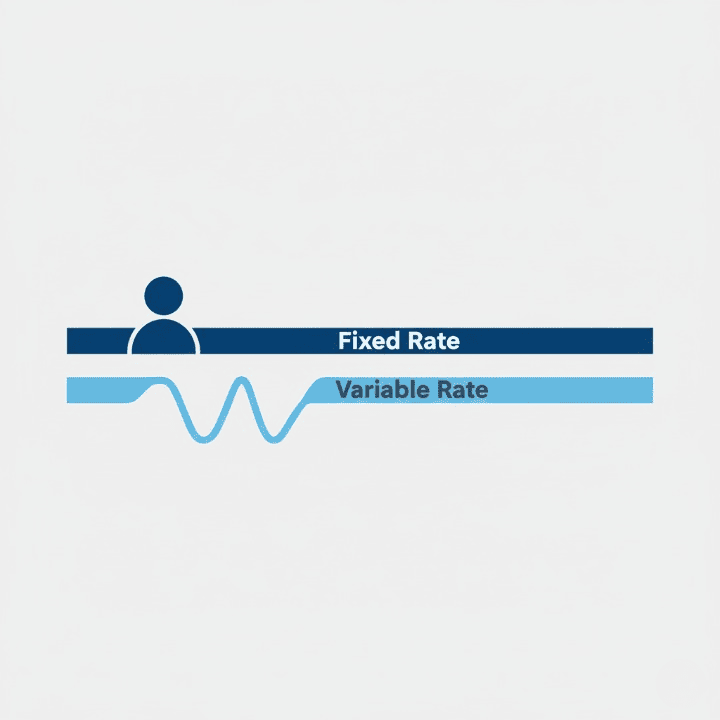
First, let’s start with the most straightforward option. A fixed interest rate is a rate that is locked in for the entire term of the loan. It will not change, regardless of what happens in the broader economy. If you sign a loan agreement with a 6% fixed interest rate, you will pay 6% for the entire life of that loan.
How it Works
The mechanics of a fixed rate are simple and predictable. Because the interest rate never changes, your required monthly payment for principal and interest will also be the exact same every single month. This makes a fixed-rate loan very easy to budget for.
The Pros of a Fixed Rate
The biggest advantage of a fixed interest rate is its stability. You have a predictable payment that you can count on. This protects you from the risk of future rate hikes. For instance, if the central bank raises interest rates and market rates go up, your rate will stay the same. This provides an incredible sense of security and peace of mind.
The Cons of a Fixed Rate
The main potential downside is that the starting rate on a fixed loan might be slightly higher than the initial introductory rate on a variable loan. You are essentially paying a small premium for the security of knowing your rate will never increase.
Common Products
Fixed rates are the standard for most long-term installment loans. For example, most mortgages, auto loans, and personal loans use a fixed interest rate.
Understanding the Variable Interest Rate
Next, let’s look at the more complex option. A variable interest rate is a rate that can, and likely will, change over time. It is not locked in for the life of the loan.
How it Works
A variable rate is typically made up of two parts. The first part is a benchmark financial index. This is an underlying interest rate that moves with the market. The second part is a “margin,” which is a fixed percentage set by the lender. Your interest rate is the index plus the lender’s margin.
Therefore, when that underlying index rate goes up or down, your interest rate also goes up or down with it. This means your required monthly payment can change periodically.
The Pros of a Variable Rate
The primary appeal of a variable rate is that the initial introductory rate is often lower than what you could get with a fixed-rate loan. This can result in a lower monthly payment at the beginning of the loan term. Furthermore, if market rates were to fall in the future, your interest rate and your monthly payment would also decrease, saving you money.
The Cons of a Variable Rate
The biggest disadvantage is the risk and uncertainty. If market rates rise, your interest rate and your monthly payment will also increase. In some cases, this increase can be significant. This makes long-term budgeting more difficult and exposes you to the risk of your payments becoming unaffordable in the future.
Common Products
Variable rates are most common for a credit card. Nearly every credit card has a variable APR. They are also common for home equity lines of credit (HELOCs). Some mortgages, known as adjustable-rate mortgages (ARMs), also have a variable rate component.
A Head-to-Head Comparison: Which is Right for You?
So, how do you decide which type of rate is right for your situation? There is no single “best” answer. The choice depends entirely on your personal financial situation and your tolerance for risk.
Consider Your Tolerance for Risk
First, you need to be honest about your comfort level with uncertainty. Are you someone who values stability and predictability above all else? If so, a fixed rate is almost always the better choice. Or, are you comfortable with some level of risk for the chance of a lower payment, and confident you can handle a potential payment increase? If so, a variable rate might be an option.
Look at the Current Interest Rate Environment
Next, you should consider the broader economy. If interest rates are historically low, it can be a very smart move to lock in that low rate for the long term with a fixed-rate loan. On the other hand, if rates are very high and economists expect them to fall in the future, a variable-rate loan might be more appealing.
Think About the Loan’s Purpose and Term
Finally, the length of the loan matters. For long-term financing, like a 30-year mortgage, a fixed rate is often the safer and more prudent choice for most people. The risk of rates rising over such a long period is significant. For a very short-term loan that you plan to pay off quickly, however, the risk associated with a variable rate is much lower.
The Impact on Your Credit and Overall Finances
The choice you make has a direct impact on your financial life. A stable, fixed-rate loan is much easier to manage within a monthly budget. This predictability helps you consistently pay your bills on time. This, in turn, is one of the best things you can do for your credit score.
A variable-rate loan, in contrast, can become a problem if the payment increases unexpectedly. A sudden jump in your required payment could strain your budget. This might lead to a late payment, which could damage your credit. Making the right choice helps you manage your debt effectively. This supports your long-term financial health and makes it easier to afford other necessities, like your insurance premiums.
Conclusion
In conclusion, the choice between a fixed and a variable interest rate is a critical decision in any borrowing scenario. It is a fundamental aspect of financial management that every consumer should understand. There is no single “best” answer that applies to everyone.
The core difference is simple. Fixed rates offer you stability and predictability. Variable rates, on the other hand, offer a potentially lower starting rate but come with the risk of future increases.
By understanding how these two types of rates work, you can better assess your own financial situation and your personal tolerance for risk. This knowledge allows you to choose the right type of financing for your specific needs. Ultimately, this will save you money and give you greater control over your financial future.