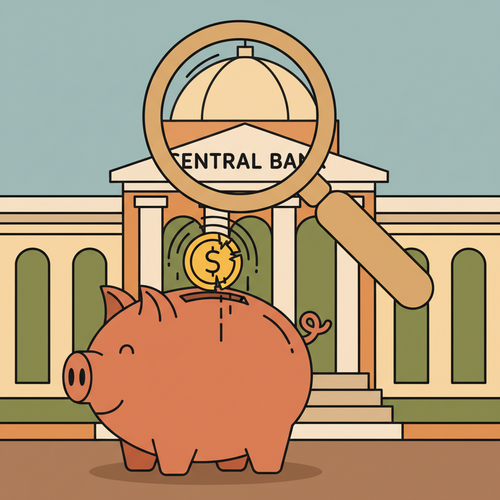
Ever wonder why your savings account isn’t earning as much interest as it used to? Central bank rate cuts are often the silent culprit behind this change. Understanding this connection is crucial for managing your money effectively, especially in today’s dynamic economic climate.
For many, a savings account feels like a safe haven for cash, a place to grow your wealth steadily. However, when central banks make a move to lower interest rates, it can directly impact how much your hard-earned money actually grows. This comprehensive guide will break down the complex world of interest rates into simple, actionable insights you can use immediately.
Quick Summary: How Rate Cuts Affect Your Savings
- 📉 Central bank rate cuts mean banks pay less interest on your deposits, directly reducing your earnings.
- 💰 Your savings account’s Annual Percentage Yield (APY) will almost certainly drop, significantly slowing your money’s growth potential.
- 💡 To counter this impact, you must proactively explore alternative savings strategies, such as high-yield online accounts or other investment vehicles.
Understanding Central Bank Rate Decisions
At the heart of global finance are central banks, entities like the Federal Reserve in the U.S., the European Central Bank (ECB), or the Bank of England. These powerful institutions manage a country’s money supply and dictate benchmark interest rates. Their decisions are not arbitrary; they are strategic moves designed to influence the broader economy.
When a central bank decides to cut its key interest rate, it’s essentially making it cheaper for commercial banks to borrow money from it. Think of this as the “wholesale price” of money for banks. When this foundational cost drops, commercial banks, in turn, tend to lower the interest rates they offer on loans and, crucially, on deposits. This action is typically taken to stimulate economic activity during periods of slowdown or recession.
- 💸 Combating Economic Slump: Central banks frequently cut rates when economic growth falters, aiming to make borrowing more attractive for businesses and consumers.
- 📈 Lower Borrowing Costs: The primary goal is to encourage spending and investment by reducing the cost of mortgages, car loans, business loans, and credit card interest.
- 📉 Preventing Deflation: Sometimes, rate cuts are used to ward off deflation, a harmful economic condition where prices fall too much, discouraging spending and investment.
- ⚖️ Balancing Act: Central banks constantly balance economic growth with inflation control, and rate cuts are a powerful tool in their arsenal.
The Direct Impact on Your Personal Savings
This is where the rubber meets the road for your personal finances. The interest rate your bank pays on your savings account isn’t determined in isolation. It’s intimately linked to the benchmark rate established by the central bank. Consequently, when the central bank announces a rate cut, your bank will almost invariably reduce the Annual Percentage Yield (APY) it offers on your deposits.
A lower APY means your savings account will generate less interest income over time. While a small percentage change might seem insignificant at first glance, its cumulative effect on your long-term savings can be substantial. This reality can be particularly frustrating if you rely on savings interest for income or to achieve specific financial goals.
Pro Tip: Be an Active Saver!
In my experience, a common mistake many beginners make is adopting a passive approach to their savings when rates fall. Don’t just accept lower earnings. Instead, proactively compare interest rates across various financial institutions. A little research can genuinely enhance your financial position over the months and years to come.
Beyond the nominal interest rate, it’s crucial to consider the “real” value of your money. If the rate of inflation – the pace at which general prices for goods and services are rising – is higher than the interest rate your savings account is earning, then your purchasing power is effectively eroding. In real terms, your money is losing value, even as its numerical balance might slightly increase. This hidden cost of inflation is a significant factor, especially during periods of low interest rates.
Strategic Moves to Protect and Grow Your Money
Feeling powerless in the face of falling rates is unnecessary. There are several proactive strategies you can employ to mitigate the impact and even boost your returns. Your first and most effective step should always be to rigorously shop around for the best available interest rates.
Don’t assume your current bank is offering the most competitive rate. Many online-only banks, for instance, typically offer significantly higher interest rates than traditional brick-and-mortar institutions. This is largely because they have lower operational overheads, allowing them to pass on those savings to their depositors in the form of better APYs. Switching banks for a better deal is a smart financial move that can directly benefit your bottom line.
| Feature | Traditional Savings Account | High-Yield Online Savings Account |
|---|---|---|
| APY (Interest Rate) | Typically much lower (e.g., 0.01% – 0.10%) | Significantly higher (e.g., 1.00% – 2.00% or more) |
| Accessibility | Physical branches, ATM networks, online banking access | Primarily online and mobile access, often limited physical locations |
| Monthly Fees | Often incur monthly service fees unless specific conditions (e.g., minimum balance, direct deposit) are met | Generally fewer or no monthly maintenance fees, promoting cost-effective savings |
| Customer Support | In-person assistance, phone, online chat; broad service range | Robust digital tools, 24/7 online and phone support are common |
| FDIC/FSCS Insurance | Yes, deposits are insured up to federal limits | Yes, deposits are insured up to federal limits, offering comparable security |
Advice
Another excellent option to consider, especially if you have funds you don’t need immediate access to, is a Certificate of Deposit (CD). CDs allow you to lock in a fixed interest rate for a predetermined period, ranging from a few months to several years. This can be particularly advantageous during periods of falling rates, as you secure a higher rate than current market offerings for the duration of your term. However, it’s important to remember that your money is typically less accessible until the CD matures without incurring penalties.
Beyond traditional savings, money market accounts (MMAs) offer a hybrid approach, often providing higher interest rates than standard savings while still allowing some check-writing or debit card access. They can be a good middle ground for those seeking better returns with some liquidity. For those with a higher risk tolerance and longer time horizons, exploring investment vehicles like bonds, mutual funds, or exchange-traded funds (ETFs) could offer potentially greater returns. Always conduct thorough research and consider consulting a qualified financial advisor, such as those found via Investopedia, before venturing into more complex investments.
The Broader Economic Landscape
While the immediate effect of rate cuts on your savings account might feel negative, it’s vital to understand their broader macroeconomic implications. Cheaper borrowing costs are a powerful tool for stimulating economic growth. Businesses may find it more attractive to expand, invest in new projects, and hire more employees. Similarly, consumers might be encouraged to take out more loans for significant purchases like homes or cars, injecting demand into the economy.
However, there’s a delicate balance. A potential unintended consequence of prolonged low rates is a rise in inflation. If the economy becomes overheated, with too much money chasing too few goods, prices for everyday items and services can begin to climb rapidly. This scenario means that your money buys less over time, further diminishing the real value of your savings, regardless of the interest rate.
- 🏡 More Affordable Mortgages: Lower interest rates can significantly reduce monthly mortgage payments, making homeownership more accessible and boosting the housing market.
- 🚗 Reduced Loan Costs: Car loans and personal loans become cheaper, potentially encouraging consumer spending and vehicle purchases.
- 📈 Potential Stock Market Boost: Lower borrowing costs can lead to higher corporate profits, which can, in turn, make company stocks more attractive to investors, potentially driving up market valuations. However, this is not a guaranteed outcome and depends on various other factors.
- 🏢 Business Expansion: Companies find it cheaper to finance expansion projects, leading to job creation and increased economic output.
Important
Understanding these intricate ripple effects allows you to form a more complete picture of how central bank decisions impact your financial world. Your personal financial strategies are always influenced by these larger economic forces. To stay ahead, make it a habit to regularly consume financial news from reputable outlets such as Bloomberg, The Wall Street Journal, or Forbes. Being informed empowers you to make smarter choices.
Conclusion
There’s no denying that central bank rate cuts directly impact your savings account by reducing the interest income you earn. This is a fundamental financial reality that every conscientious saver must acknowledge and address. However, possessing this knowledge is a powerful asset.
By understanding how rate changes work and exploring alternative savings and investments, you can reduce their negative impact. Don’t let your money languish; take decisive charge of your financial future today. What specific steps will you commit to taking this week to optimize your savings and ensure your money works harder for you?