Executive Summary
- Yield curve dynamics offer critical forward-looking economic indicators for financial institutions.
- Interest rate shifts fundamentally impact asset-liability management and investment portfolio duration.
- Effective debt restructuring models mitigate systemic risk and ensure capital structure resilience.
Yield Curve Inversion: A Harbinger of Economic Shifts
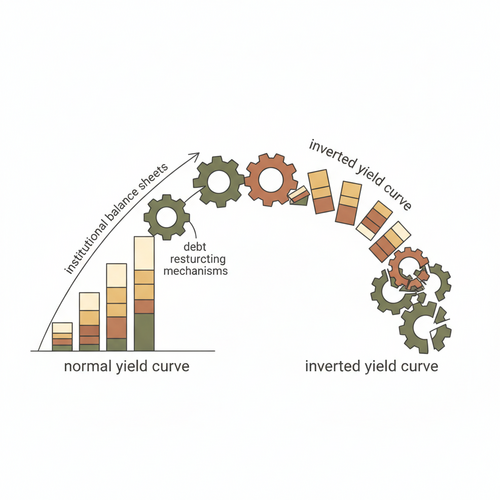
The yield curve graphically plots bond yields against their maturities. A normal curve slopes upward, reflecting higher compensation for longer-term commitments. Conversely, an inverted yield curve signals impending economic contraction. This phenomenon occurs when short-term interest rates exceed long-term rates. Market participants interpret this as a lack of confidence in future economic growth prospects. Central bank policy significantly influences these dynamics.
Understanding Term Premium and Market Expectations
The term premium compensates investors for holding longer-dated assets. It accounts for future inflation risk and interest rate volatility. An inverted curve often implies a negative term premium. This suggests market participants anticipate future rate cuts. Such an expectation usually stems from a projected economic slowdown. Forward-looking inflation expectations also play a crucial role in shaping the curve. Disinflationary pressures can steepen or flatten the curve.
Quantitative Easing and Yield Curve Manipulation
Quantitative Easing (QE) programs involve large-scale asset purchases. Central banks target specific maturities to depress long-term yields. This injects liquidity and stimulates economic activity. Conversely, Quantitative Tightening (QT) withdraws this liquidity. QT can lead to a steepening of the yield curve. These interventions directly manipulate market rates. They also alter investor behavior and risk perceptions.
Duration Mismatch and Interest Rate Sensitivity
Financial institutions, particularly banks and insurance companies, face significant duration risk. Their assets and liabilities often possess different maturities. A duration mismatch arises when these differences are substantial. Rising interest rates can sharply devalue long-duration assets. This directly impacts portfolio valuations. Liabilities, however, may reprice more slowly. This disparity can erode net interest income and capital bases. Effective risk management necessitates active monitoring. Institutions must adjust portfolios to mitigate these exposures.
Strategic Implications for Asset-Liability Management (ALM)
Asset-Liability Management (ALM) is paramount for institutional stability. It balances risk and return across an organization’s balance sheet. Yield curve movements directly inform ALM strategies. A flattening curve might prompt a shift to shorter-duration assets. This reduces interest rate sensitivity. Conversely, a steepening curve could encourage longer-duration investments. This captures higher term premiums. Sophisticated institutions employ dynamic hedging techniques. They use derivatives to manage interest rate exposure. Regular stress testing is also essential. This assesses portfolio resilience under adverse scenarios.
Expert Insight: “Managing duration risk effectively during periods of yield curve volatility requires a nuanced understanding of market sentiment and central bank forward guidance. Proactive adjustments, not reactive measures, dictate long-term portfolio performance.”
Institutional Debt Restructuring: Frameworks and Objectives
Debt restructuring becomes necessary when an entity faces solvency or liquidity challenges. The objective is to realign debt obligations with repayment capacity. This avoids outright default or bankruptcy. Restructuring involves altering existing loan terms. These changes can include maturity extensions or interest rate reductions. Creditors often accept these concessions. This maximizes recovery value over a forced liquidation. Multiple models exist for different scenarios.
Sovereign Debt Restructuring Mechanics
Sovereign debt restructuring involves a country renegotiating its external debt. This process is complex and often politically charged. Key mechanisms include bond exchanges and principal haircuts. Collective Action Clauses (CACs) facilitate orderly restructuring. They bind all creditors to majority decisions. The Paris Club and London Club historically played significant roles. Transparency and equitable burden-sharing are critical. Debt restructuring aims to restore fiscal sustainability. It avoids protracted financial instability.
Corporate Debt Restructuring and Workout Strategies
Corporate debt restructuring typically occurs under legal frameworks like Chapter 11 in the U.S. Informal out-of-court workouts are also common. These involve direct negotiations between the company and its creditors. Strategies include debt-for-equity swaps. This converts debt into ownership stakes. Asset sales can generate liquidity for repayment. Renegotiating covenants and maturity dates is standard. The goal is to preserve enterprise value. It also ensures operational continuity. Creditor committees play a central role in these negotiations.
The Role of Collective Action Clauses (CACs) and Pari Passu Provisions
CACs significantly streamline sovereign debt renegotiations. They prevent holdout creditors from disrupting agreements. Without CACs, a minority of creditors could block a deal. This forces a less favorable resolution. The inclusion of CACs has become a standard practice. They enhance the predictability of sovereign debt workouts. Pari passu clauses ensure equal treatment among creditors. However, their interpretation has sometimes led to legal disputes. These disputes can complicate restructuring efforts. Clear contractual language is thus paramount. Such provisions are critical for global financial stability.
Macroeconomic Policy Interplay and Moral Hazard Considerations
Macroeconomic policy responses heavily influence restructuring outcomes. Central bank liquidity support can prevent immediate defaults. Fiscal austerity measures might also be implemented. This demonstrates a commitment to reform. However, such interventions raise moral hazard concerns. Bailouts could incentivize excessive risk-taking in the future. Policymakers must balance financial stability with moral hazard. Striking this balance is crucial. It ensures market discipline and responsible lending. The International Monetary Fund (IMF) often plays a supervisory role. Its programs link financial assistance to structural reforms. This aims to foster long-term stability.
Case Studies: Lessons from Recent Restructurings
Historical instances provide valuable insights into restructuring efficacy. The Eurozone sovereign debt crisis exemplified complex negotiations. Greece’s debt reprofiling highlighted challenges. It involved private sector involvement and official sector support. Argentina’s recurrent defaults illustrate holdout creditor issues. Legal battles over pari passu clauses protracted resolutions. Lessons learned emphasize the importance of robust legal frameworks. They also underscore multilateral cooperation. Early intervention mechanisms are vital. This minimizes economic disruption. Proactive engagement with all stakeholders proves critical. These cases inform current best practices. Yield curve dynamics often foreshadow these fiscal stresses.
Conclusion
The intricate relationship between macroeconomic yield curve dynamics and institutional debt restructuring models remains fundamental. Understanding these forces enables proactive risk management. It also informs strategic capital allocation. Financial institutions must continuously adapt their frameworks. This ensures resilience against evolving market conditions. Robust ALM and sophisticated restructuring capabilities are not optional. They are indispensable for navigating global financial complexities. How will financial innovations further refine these critical economic functions?