Introduction
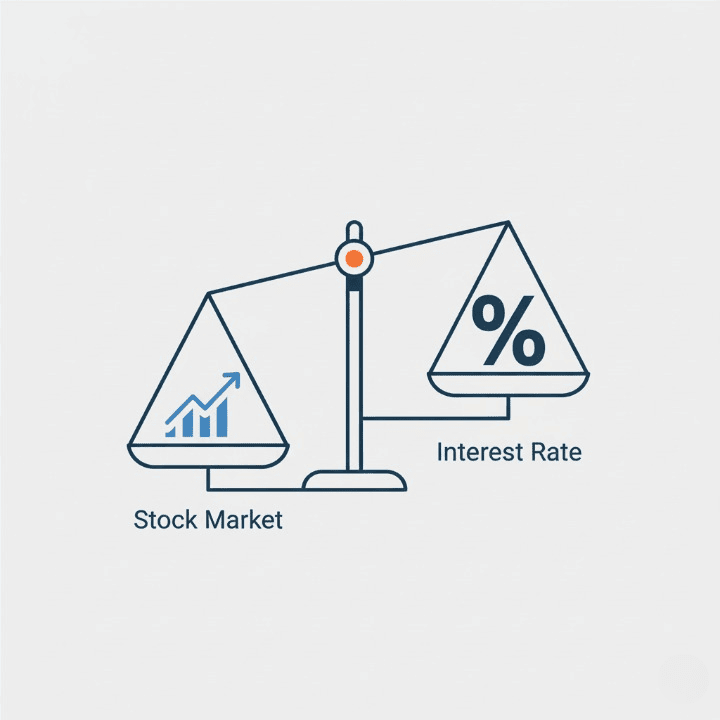
If you follow financial news, you have likely noticed a common pattern. When the nation’s central bank announces a change to the key interest rate, the stock market often has a swift and significant reaction. A rate hike can send the market tumbling, while a rate cut can sometimes spark a rally. This is not a coincidence.
The level of interest rates is one of the most powerful forces that influences the direction of the stock market. For any investor, understanding this complex relationship is a crucial piece of financial literacy. It can help you make sense of market volatility and become a more informed participant in the financial world. This guide will break down this important connection in simple, easy-to-understand terms.
The Fundamental Relationship: Borrowing Costs and Company Profits
First, let’s explore the most direct link between interest rates and stock prices. Businesses, just like people, often need to borrow money. They use this financing to fund their operations and growth. For example, a company might take out a loan to build a new factory, develop a new product, or hire more employees.
When the central bank raises the interest rate, the cost of this corporate borrowing also goes up. A company’s existing variable-rate debt becomes more expensive. Any new loans they take out will also come with a higher interest rate. These higher loan payments directly impact the company’s bottom line. They lead to lower profits.
Lower profits, in turn, make a company’s stock less attractive to investors. If a company is earning less money, it has less to reinvest in the business and less to return to shareholders. As a result, its stock price may fall. Conversely, when interest rates are low, borrowing is cheap. This can boost corporate profits and make stocks more appealing to investors.
The “TINA” Effect and Investor Alternatives
Next, we need to understand the concept of relative value. Investors are always looking for the best possible return on their money. Their decisions are often a comparison between different types of assets, primarily stocks and bonds.
The Low Interest Rate Environment: “There Is No Alternative” (TINA)
When the central bank sets interest rates very low, the returns on safe investments become very unattractive. For example, government bonds and high-yield savings accounts might offer a return that is close to zero, or even below the rate of inflation.
In this situation, investors who are seeking a decent return are often “forced” to put more of their money into the stock market. While stocks are riskier, they offer a much higher potential for growth. This is often called the “TINA” effect, which stands for “There Is No Alternative.” This increased demand for stocks from a wide range of investors can help to drive the entire market higher.
The High Interest Rate Environment: Bonds Become Attractive
The situation changes completely when the central bank raises rates. Suddenly, those safe government bonds become much more attractive. A new government bond might now offer a relatively safe, guaranteed return of 4% or 5%.
This new, higher rate on bonds now directly competes with the potential returns of the stock market. Some conservative investors may decide that a guaranteed 5% return is better than the uncertain potential of stocks. As a result, they may sell some of their stocks and move that money into the safety of bonds. This decreased demand for stocks can cause the overall market to fall. Major investors, like insurance companies, manage huge bond portfolios and are very active during these shifts.
How Different Types of Stocks are Affected
It is also important to note that not all stocks react to interest rate changes in the same way.
Growth Stocks
Growth stocks are typically shares in companies that are expected to grow their profits very quickly in the future. Many technology companies fall into this category. The value of these stocks is heavily based on those high future earnings. However, higher interest rates make those distant, future earnings less valuable in today’s dollars. For this reason, growth stocks are often hit the hardest when interest rates rise.
Value Stocks
Value stocks, on the other hand, are often shares in more established, stable companies. This can include sectors like banking, utilities, and consumer goods. These companies tend to have more predictable, current profits and often pay a consistent dividend. They can sometimes perform better, or at least be more stable, than growth stocks in a rising-rate environment.
The Broader Economic Picture
Finally, interest rates have a powerful influence on the overall health of the economy. This, in turn, has a major impact on the stock market.
Higher interest rates are a tool used to slow down an overheating economy and fight inflation. They make it more expensive for consumers to borrow money for big purchases. For instance, it increases the cost of mortgages and auto loans. It can also increase the interest on credit card debt. This can lead to lower consumer spending. When people spend less, corporate revenues fall, which is generally bad for stock prices.
Lower interest rates are designed to do the opposite. They stimulate the economy by making borrowing cheaper. This can encourage both consumer and business spending. This often leads to more jobs and higher corporate profits, which is generally very good for stocks and for the overall credit market.
Conclusion
In summary, the level of the key interest rate has a powerful and generally inverse relationship with the stock market. There is a clear logic behind this connection.
We have seen that higher rates can hurt the stock market for three main reasons. First, they increase borrowing costs for companies, which reduces their profits. Second, they make safer investments, like bonds, much more attractive alternatives. Third, they can slow down the overall economy, which leads to lower consumer spending.
As an investor, you cannot control the interest rate decisions made by the central bank. However, by understanding how these decisions affect the market, you can better understand market volatility. You will not be surprised when the market reacts to economic news. This knowledge helps you to remain a calm, informed, and long-term investor. Ultimately, this understanding is key to protecting the health of your investment portfolio.